


 Ada Pertanyaan? Hubungi Kami


2026 Hak Cipta Milik Hukumonline.com
Produk Pilihan


 Ada Pertanyaan? Hubungi Kami
Marcell Sihombing, M. Agus Yozami/ANT
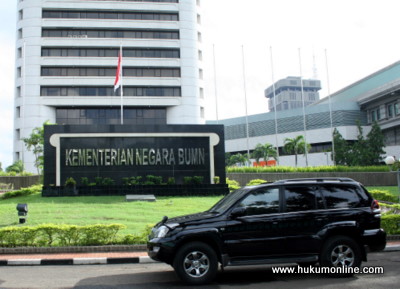
Ministry of State-Owned Enterprises. Photo by: RES
Rini Soemarno, the Minister of State-Owned Enterprises, recently announced that the government is currently deliberating a draft government regulation on the establishment of holding companies for state-owned enterprises (Draft Regulation), and that this Draft Regulation is being reviewed by various relevant ministries. This announcement was revealed during a coordination meeting which was held in Jakarta on Thursday, 18 August 2016.
“We will discuss the preparation of the Draft Regulation, the revision of various implementing regulations and the various parties which will have to be communicated with,” asserted Minister Soemarno.
The coordination meeting discussed the follow-up to the plan to establish holding companies for state-owned enterprises. The meeting itself was presided over by Coordinating Minister for Economic Affairs, Darmin Nasution, and was also attended by Indonesia’s new Minister of Finance, Sri Mulyani Indrawati, and the Minister of Law and Human Rights, Yasonna H. Laoly.
Indeed, the government has been intending to establish holding companies for state-owned enterprises operating across five private sectors, namely energy, toll-road infrastructure, mining, housing and financial services, for a while now. Nevertheless, Minister Soemarno still asserts that he cannot determine when the Draft Regulation will ultimately be issued. Minister Laoly is of the same opinion as Minister Soemarno, and only stated for the record that the regulation was currently still under assessment.
“It [the Draft Bill] is still being thoroughly and meticulously assessed, including aspects which relate to governance, companies, the law and so forth. We are taking this one step at a time. Slowly but surely,” Minister Laoly stated.
Minister Laoly is also hoping to ensure that state-owned enterprises, which are the state’s pivotal point in terms of its business activities, will be entitled to enjoy certain privileges through the performance of their day-to-day business operations, as they compete with privately owned companies.
President Joko Widodo has declared that the establishment of such holding companies is being aimed squarely at strengthening state-owned enterprises, as they engage in both local and global competition. The president is also demanding that all state-owned enterprises take a proactive role as regards stimulating the national economy. In this regard, President Widodo has instructed the Secretary of the Cabinet and the Coordinating Minister for Economic Affairs to properly synchronize all of the relevant regulatory frameworks which are related to this particular issue.
“We don’t want the establishment of holding companies and the appointment of their management personnel to entail legal issues at a later date due to their regulatory framework having not been properly prepared,” Secretary of the Cabinet Pramono Anung asserted.
Mr. Anung further asserted that the process would also involve the House of Representatives as well as the Audit Board of Indonesia (BPK) in order to ensure that the establishment properly reflects Article 33 of the Constitution, which focuses upon the principle of economic development for the people.
Muhammad Faiz Aziz, a researcher from the Indonesian Center for Law and Policy Studies (Pusat Studi Hukum dan Kebijakan Indonesia - PSHK), also recently highlighted a number of issues which may arise as regards the establishment of holding companies for state-owned enterprises, specifically as they relate to the legal status of state-owned enterprises.
Indeed, according to Article 1 (1) of Law No. 19 of 2003 on State-Owned Enterprises, a state-owned enterprise is a company that is either partially or wholly owned by the state through direct (capital) investment which is derived from state assets that are held separately from the state treasury. Thus, only holding/parent companies can constitute state-owned enterprises, while their subsidiaries cannot, due to the fact that such subsidiaries were originally established through an indirect tiered-investment process.
Ministry of State-Owned Enterprises Still Necessary
Vice-President Jusuf Kalla has also weighed into the current debate. According to the Vice-President, the Ministry of State-Owned Enterprises will still need to oversee the five holding companies which will be established.
“A Minister’s role is to issue policies, not run companies. Thus, the Ministry of State-Owned Enterprises should remain,” Kalla asserted.
Vice-President Kalla further stated that the Ministry of State-Owned Enterprises represented the government as a shareholder in various state-owned enterprises. Although prevailing laws and regulations stipulate that the Ministry of Finance represents the government as a shareholder, in practice this task is delegated to the Ministry of State-Owned Enterprises.
“So, without the Ministry of State-Owned Enterprises, who will represent the government as shareholder?” the Vice-President Kalla asked rhetorically.
Coming from a slightly different perspective, Vice-President Kalla asserted his firm belief that the Minister of State-Owned Enterprises policy to establish holding companies was aimed squarely at the unification of companies engaging in the same businesses in order to simplify coordination and oversight, as well as to prevent any double investments.
“Take the State Gas Company (Perusahaan Gas Negara - PGN) and the State Oil-and-Gas Company (Pertambangan Minyak dan Gas Bumi Negara - Pertamina) as an example. Both parties have the right to construct gas pipelines, however these rights can sometimes overlap. Under a holding-company system, such problems can be avoided,” Vice-President Kalla concluded.
(hs/sp)
Marcell Sihombing, M. Agus Yozami/ANT
Ministry of State-Owned Enterprises. Photo by: RES
Rini Soemarno, the Minister of State-Owned Enterprises, recently announced that the government is currently deliberating a draft government regulation on the establishment of holding companies for state-owned enterprises (Draft Regulation), and that this Draft Regulation is being reviewed by various relevant ministries. This announcement was revealed during a coordination meeting which was held in Jakarta on Thursday, 18 August 2016.
“We will discuss the preparation of the Draft Regulation, the revision of various implementing regulations and the various parties which will have to be communicated with,” asserted Minister Soemarno.
The coordination meeting discussed the follow-up to the plan to establish holding companies for state-owned enterprises. The meeting itself was presided over by Coordinating Minister for Economic Affairs, Darmin Nasution, and was also attended by Indonesia’s new Minister of Finance, Sri Mulyani Indrawati, and the Minister of Law and Human Rights, Yasonna H. Laoly.
Indeed, the government has been intending to establish holding companies for state-owned enterprises operating across five private sectors, namely energy, toll-road infrastructure, mining, housing and financial services, for a while now. Nevertheless, Minister Soemarno still asserts that he cannot determine when the Draft Regulation will ultimately be issued. Minister Laoly is of the same opinion as Minister Soemarno, and only stated for the record that the regulation was currently still under assessment.
“It [the Draft Bill] is still being thoroughly and meticulously assessed, including aspects which relate to governance, companies, the law and so forth. We are taking this one step at a time. Slowly but surely,” Minister Laoly stated.
Minister Laoly is also hoping to ensure that state-owned enterprises, which are the state’s pivotal point in terms of its business activities, will be entitled to enjoy certain privileges through the performance of their day-to-day business operations, as they compete with privately owned companies.
President Joko Widodo has declared that the establishment of such holding companies is being aimed squarely at strengthening state-owned enterprises, as they engage in both local and global competition. The president is also demanding that all state-owned enterprises take a proactive role as regards stimulating the national economy. In this regard, President Widodo has instructed the Secretary of the Cabinet and the Coordinating Minister for Economic Affairs to properly synchronize all of the relevant regulatory frameworks which are related to this particular issue.
“We don’t want the establishment of holding companies and the appointment of their management personnel to entail legal issues at a later date due to their regulatory framework having not been properly prepared,” Secretary of the Cabinet Pramono Anung asserted.
Mr. Anung further asserted that the process would also involve the House of Representatives as well as the Audit Board of Indonesia (BPK) in order to ensure that the establishment properly reflects Article 33 of the Constitution, which focuses upon the principle of economic development for the people.
Muhammad Faiz Aziz, a researcher from the Indonesian Center for Law and Policy Studies (Pusat Studi Hukum dan Kebijakan Indonesia - PSHK), also recently highlighted a number of issues which may arise as regards the establishment of holding companies for state-owned enterprises, specifically as they relate to the legal status of state-owned enterprises.
Indeed, according to Article 1 (1) of Law No. 19 of 2003 on State-Owned Enterprises, a state-owned enterprise is a company that is either partially or wholly owned by the state through direct (capital) investment which is derived from state assets that are held separately from the state treasury. Thus, only holding/parent companies can constitute state-owned enterprises, while their subsidiaries cannot, due to the fact that such subsidiaries were originally established through an indirect tiered-investment process.
Ministry of State-Owned Enterprises Still Necessary
Vice-President Jusuf Kalla has also weighed into the current debate. According to the Vice-President, the Ministry of State-Owned Enterprises will still need to oversee the five holding companies which will be established.
“A Minister’s role is to issue policies, not run companies. Thus, the Ministry of State-Owned Enterprises should remain,” Kalla asserted.
Vice-President Kalla further stated that the Ministry of State-Owned Enterprises represented the government as a shareholder in various state-owned enterprises. Although prevailing laws and regulations stipulate that the Ministry of Finance represents the government as a shareholder, in practice this task is delegated to the Ministry of State-Owned Enterprises.
“So, without the Ministry of State-Owned Enterprises, who will represent the government as shareholder?” the Vice-President Kalla asked rhetorically.
Coming from a slightly different perspective, Vice-President Kalla asserted his firm belief that the Minister of State-Owned Enterprises policy to establish holding companies was aimed squarely at the unification of companies engaging in the same businesses in order to simplify coordination and oversight, as well as to prevent any double investments.
“Take the State Gas Company (Perusahaan Gas Negara - PGN) and the State Oil-and-Gas Company (Pertambangan Minyak dan Gas Bumi Negara - Pertamina) as an example. Both parties have the right to construct gas pipelines, however these rights can sometimes overlap. Under a holding-company system, such problems can be avoided,” Vice-President Kalla concluded.
(hs/sp)