| Issue Number : 840

Understanding Renvoi Procedure: Achievable Objectives and Process Walkthrough

Overview

During processes that relate to bankruptcy proceedings, specifically during the stage that involves the matching of the values of receivables, significant differences often emerge between the values that are proposed by creditors and those that are acknowledged by debtors that cannot be settled by the supervisory judge. The differences that arise between a creditor and a debtor can often create gaps that lead to the creation of fictional creditors, which may ultimately hinder attempts that are made by the parties involved in bankruptcy proceedings to seek fairness and justice.[1]

Matters that specifically relate to bankruptcy proceedings are regulated under Law No. 37 of 2004 on Bankruptcy Proceedings and the Suspension of Debt Payment Obligations (Penundaan Kewajiban Pembayaran Utang – “PKPU”), as has been amended several times, most recently through the introduction of Law No. 4 of 2023 (collectively referred to as “Law 37/2004”). Law 37/2004  states that there are three types of creditors during bankruptcy proceedings, specifically: 1) Concurrent creditors; 2) Separatist creditors; and 3) Preferential creditors.[2] The term “fictional creditors” was first acknowledged by the Commercial Court of Central Jakarta during the case of International Finance Corporation vs. PT. Panca Overseas Finance Tbk, which defined the term as a creditor who has no legal receivables and hence does not possess any official documents proving their receivables from the relevant debtor. Sometimes, fictional creditors may also forge documents in order to prove the existence of said receivables so that they are able to secure the right to vote during creditors’ meetings.[3]

Fictional creditors may potentially appear on both sides of the parties to bankruptcy proceedings since there is a potential for said fictional creditors to be “planted” by debtors who have been declared bankrupt in order to regain their assets through the claiming of fictional receivables.[4] One stage of the overall bankruptcy proceedings process that may help tackle the creation of fictional creditors is the so-called renvoi procedure, which allows for objections to be filed over any differences that emerge between creditors and debtors regarding the values of receivables and which could not be solved by the relevant supervisory judges. The renvoi procedure is legally recognized under Law 37/2004 as a form of objection and allows for a supervisory judge to order both parties to the relevant bankruptcy proceedings to settle any dispute that arises in relation to an objection in the commercial court.[5]

The renvoi procedure, which can erase the presence of any fictional creditors, was successfully used during bankruptcy proceedings that were initiated in relation to PT Rockit Aldeway. In this case, PT Bank Mandiri Tbk, as one of the case creditors, submitted a request for the renvoi procedure to PT Rockit Aldeway’s curator team due to the presence of 13 questionable creditors on the relevant receivables. The verification of the receivables claimed by the 13 creditors was not subsequently completed by the curator team, which ultimately led to PT Bank Mandiri Tbk submitting an application for the initiation of the renvoi process. Following the process, it was decided by the court that the 13 creditors in question would be erased from the list of creditors, as it had been proven beyond reasonable doubt that they were not the legitimate creditors of the bankrupt debtor.[6]

Against this backdrop, it should be noted that despite only representing a small part of the overall bankruptcy proceedings, the renvoi procedure may determine whether or not the settlement of a given set of bankruptcy proceedings will achieve fairness for the parties involved. Accordingly, in this edition of Indonesian Law Digest, Hukumonline offers an analysis and summary of the various procedural matters that relate to renvoi procedures during bankruptcy proceedings, along with a guide that can be used in order to prepare renvoi procedures based on case studies of existing precedents. In order to support this discussion, our analysis draws on the following legal instruments:

  1. Law 37/2004; and
  2. Decree of the Head of the Supreme Court (Mahkamah Agung – “MA”) No. 109/KMA/SK/IV/2020 of 2020 on the Implementation of the Guidebook for the Settlement of Bankruptcy Proceedings and PKPU (“Bankruptcy Guidebook”).

In order to provide a clearer discussion of this matter, this edition of Indonesian Law Digest (ILD) has been divided up as follows:

  1. Understanding the Renvoi Procedure During Bankruptcy Proceedings
  2. A Walkthrough of the Renvoi Procedure During Bankruptcy Proceedings
  3. A Guide to the Preparation of the Renvoi Procedure
  1. Precedent-Based Analysis of the Renvoi Procedure
  2. Lessons Learned and Recommendations


I.    Understanding the Renvoi Procedure During Bankruptcy Proceedings

Prior to engaging in any further discussion of the renvoi procedure, it is important to understand the overall flow of bankruptcy proceedings. The timeline below represents the process flow of bankruptcy proceedings, starting from the registration of a petition and concluding with a declaration of bankruptcy through the issuance of a legally binding court decision:
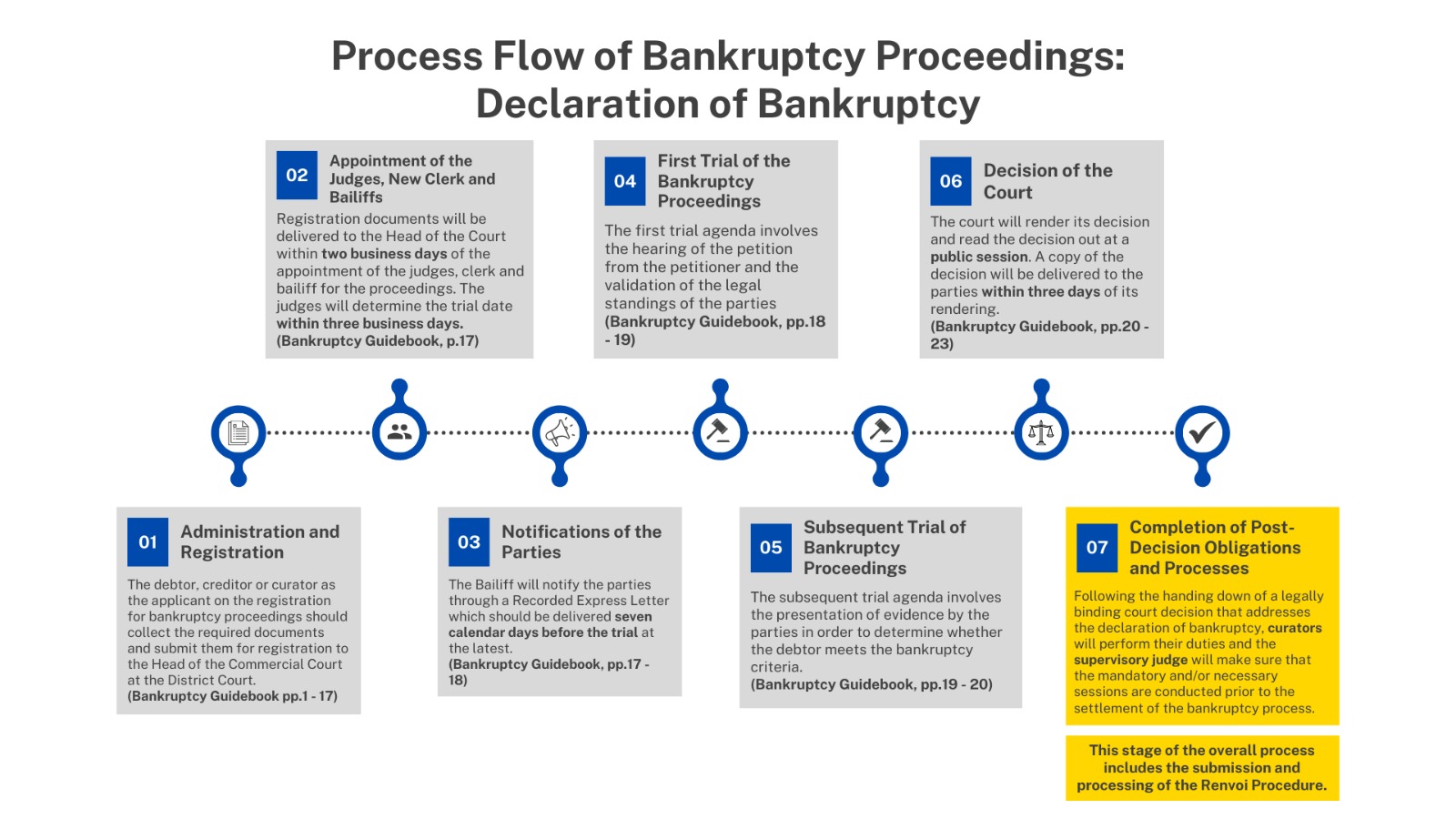
As highlighted in the timeline above, the renvoi procedure is initiated in order to fully complete any bankruptcy proceedings process that takes place after a legally binding court decision regarding a declaration of bankruptcy has been rendered. In order to offer a further breakdown of the bankruptcy completion process, the timeline below represents the various process stages that should be undertaken after a declaration of bankruptcy has been rendered through the issuance of a legally binding court decision:[7]
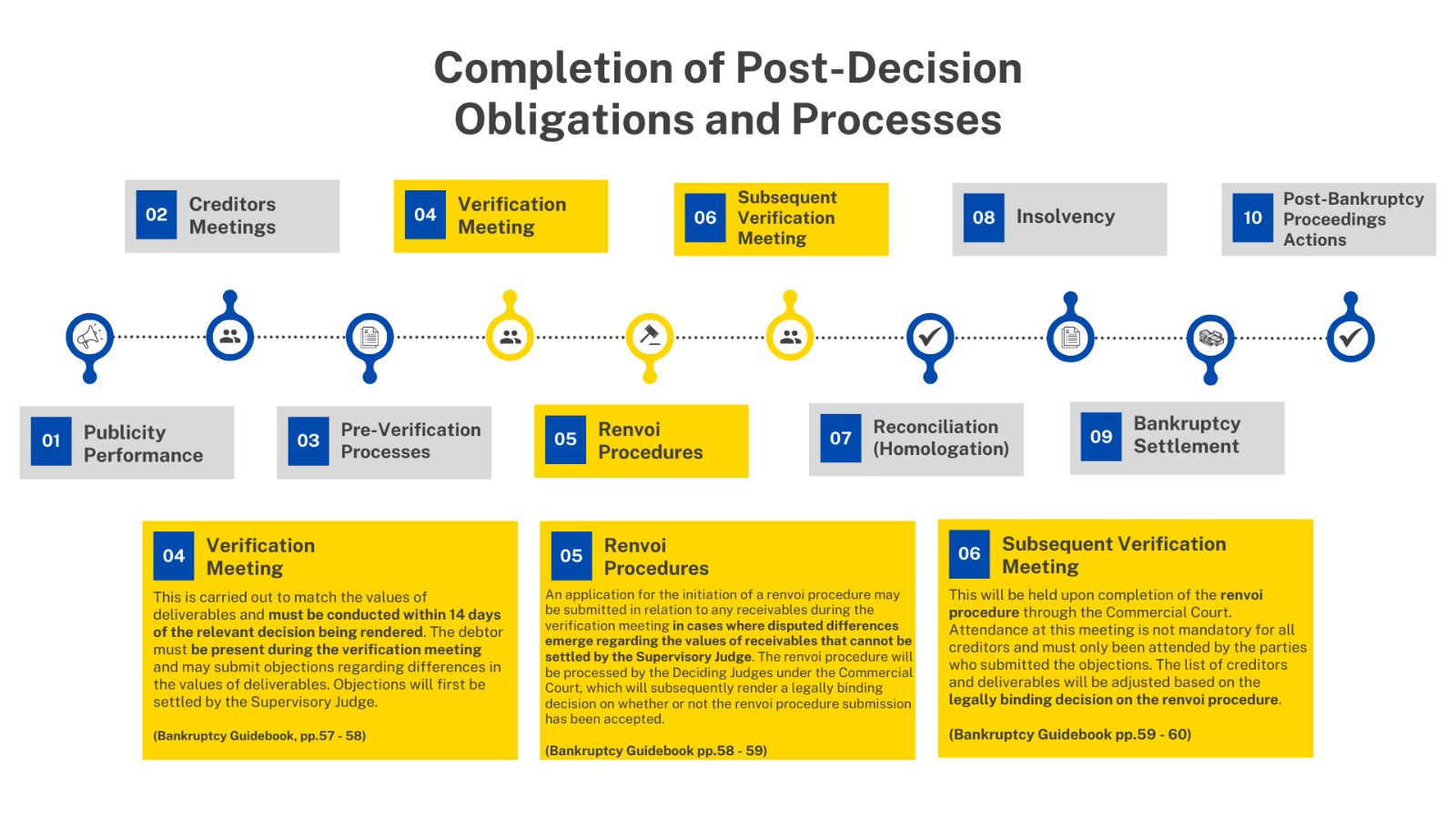
The discussion set out in this analysis will focus on the stages highlighted in the above infographic, specifically: verification meeting, renvoi procedures and subsequent verification meeting.

Within 14 days of bankruptcy being declared through the issuance of a legally binding court decision, the Supervisory Judge must determine the following matters: [8]

  1. Deadline for the submission of the receivables;
  2. Deadline for the tax verification; and
  3. Date, time and location of the relevant creditors meeting, as well as verification meetings in order to match the receivables.

As a part of the performance of their duties, the relevant curators will inform all of the creditors involved in a given case of the above-described stipulations. Upon the sending of these notifications by the relevant curators, the creditors must submit their list of receivables along with the relevant calculations or other supporting documents that specify the nature and value of the receivables. The submitted list of receivables will then be verified by the curators during a verification meeting during which creditors, debtors and receivers can either reject or approve the submitted claims in accordance with the list of acknowledged receivables that is read out by the supervisory judges.[9] As mentioned in the brief introduction above, the debtor must be present in person at the verification meeting, otherwise, the debtor will be deemed to have approved the amount that is being claimed by the creditors. [10]

In terms of the potential presence of fictional creditors, such creditors may be invoked as a result of two potential interests: 1) Division of the bankruptcy assets so that the initial creditors will recover less of their rightful shares; or 2) Securing of a vote for reconciliation.[11] Either way, the only process that is set out under the framework of Law 37/2004 in order to tackle any fictional creditors is the initiation of a verification meeting, followed by a renvoi procedure. The verification meeting allows for the relevant parties to raise objections concerning the presented values of receivables and thus allows for the pointing out of any potentially suspicious creditors in relation to the receivables. While objections may be raised by the attending debtors during the verification meeting,[12] any objections and disputed facts that arise during the meeting and that cannot be resolved by the Supervisory Judge will be processed through the initiation of a renvoi procedure.[13]

Legally speaking, the renvoi procedure is recognized under Article 127 of Law 37/2004 as a form of objection that can be settled outside of a verification meeting. Renvoi procedures will be examined in a simple proceedings manner, while any such examination proceedings must be attended by the relevant objectors in question. The absence of said objectors will result in an objection waiver to the renvoi procedure.[14]

Aside from being recognized under Law 37/2004, several legal precedents serve as ratio decidendi and offer further insights into the renvoi procedure process, as summarized in the table below:

Court Decisions

Renvoi Procedure Statements

Decision of the MA No. 77/Pdt.Sus-Renvoi prosedur/2015/PN.Niaga.Jkt.Pst jo. No. 77/Pdt.Sus/PKPU/2015/PN.Niaga.Jkt.Pst jo. No. 77/Pdt.Sus/PAILIT/2015/PN.Niaga.Jkt.Pst

The renvoi procedure is characterized by the presence of a list of receivables that are objected to by the curators when the dispute is handed over to the court.

Decision of the MA No. 940/Pdt.Sus/2010

The renvoi procedure is lex specialis in a civil arbitration process, which leads to the renvoi procedure having greater legally binding force than arbitration.

Decision of the Commercial Court at the District Court of Central Jakarta No. 2016.K/Pdt.Sus/2011

In order to submit a renvoi procedure application, a list of receivables has to be submitted by the creditors in order to be matched and verified by the curators. In cases where there is no list of receivables and there is an absence of any participation in the verification process by the curators, the renvoi procedure application will be deemed inadmissible.

Decision of the MA No. 022/K/N/2005

At its core, the processes involved in the renvoi procedure comprise a form of objection that is raised during the relevant bankruptcy proceedings, calculations relating to which will be completed by the court.

The overall process flow for the commencement of the renvoi procedure during any bankruptcy proceedings is further elaborated upon in the following section.


II.  A Walkthrough of the Renvoi Procedure During Bankruptcy Proceedings

It has been established that the renvoi procedure is a part of bankruptcy proceedings which must be carried out after a debtor has been declared bankrupt. The flowchart below summarizes the overall process flow of the renvoi procedure:
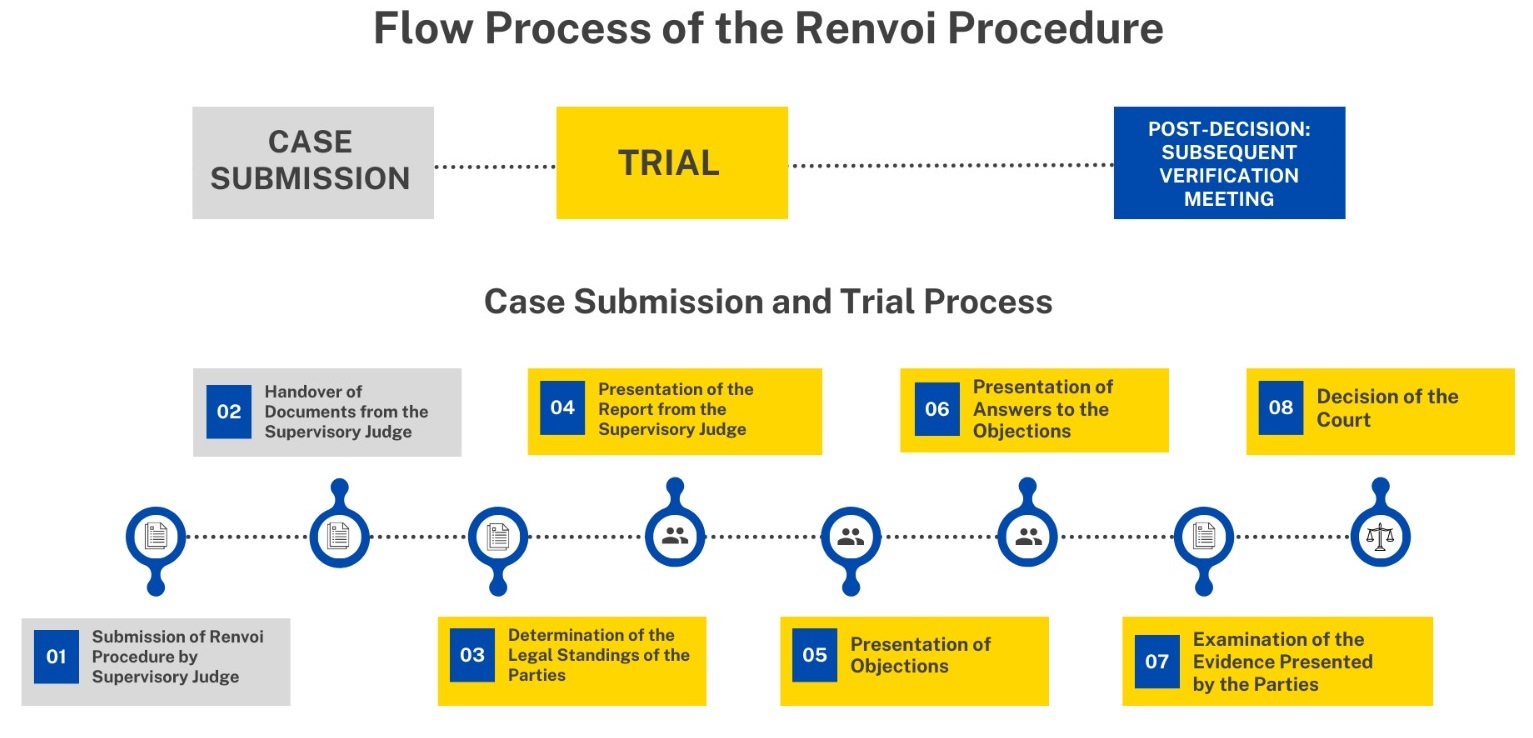
In order to provide a more thorough walkthrough of the renvoi procedure, provided below are summaries of the various aspects and requirements that have to be taken into account during each stage of the renvoi procedure process:

Preconditions for Renvoi Procedure Submissions

An analysis of the various elements set out under Article 127 of Law 37/2004 affirms that the preconditions that must be fulfilled in order for a renvoi procedure to be deemed admissible break down as follows:

  1. There must be an objection which could not be resolved by the Supervisory Judge and which was raised during the verification meeting. Objections relating to any list of receivables that were not previously disputed during the verification meeting or which have been raised outside of the verification meeting do not qualify for the initiation of the renvoi procedure.[15]
  2. The renvoi procedure process may only be initiated through an order of the Supervisory Judge.[16]
  3. An attempt must have been made to resolve the dispute through the court.[17]
  4. The disputed subject matter must relate to the dispute on the list of submitted receivables. Objections relating to subject matter other than the submitted receivables cannot be resolved through the renvoi procedure.[18]

Case Submissions and Handovers of Documents by the Supervisory Judge

While the preconditions for objections to be processed through the initiation of the renvoi procedure are established above, it is also important to note that several elements must be taken into account during case submissions for the renvoi procedure, as summarized below:

  1. As the process may only be carried out in line with the orders of the Supervisory Judge, any submission of an application for the initiation of the renvoi procedure must also be made by the Supervisory Judge through the handing over of relevant documents, which should include the relevant evidence and filed objections.[19]
  2. The submission of the renvoi procedure application must be made to the same Judges who previously rendered the decision on the declaration of bankruptcy.[20]

Legal Standing of the Parties

During the renvoi procedure trial process, several aspects must be taken into account in order to prevent the dismissal of the case due to a lack of legal standing and/or as a result of procedural matters. Said aspects are set out below:

  1. Parties must be represented by advocates.[21]
  2. Creditors must be present during the renvoi procedure in order for the case to be deemed admissible. Any creditors who are absent during the trial will be declared to have withdrawn their objections.[22]
  3. The creditors who can participate and intervene in the renvoi procedure are defined as those who previously raised objections during the verification meeting.[23]

Decision of the Court

Upon completing the examination of the objections and the supporting evidence, the judges will render a decision on whether or not the renvoi procedure application has been accepted. In this regard, Law 37/2004 states that any relevant parties have the right to submit an appeal within five days of the rendering of a given decision. However, it should also be noted that decisions on the renvoi procedure are exempted from this provision. As a result, the right of appeal is not exercisable in relation to any decisions on renvoi procedure.[24] Nevertheless, in terms of actual renvoi procedure practice, the relevant parties are usually permitted to submit cassations in relation to any decision of the court.[25] Once a final and legally binding court decision on a renvoi procedure has been rendered, a subsequent verification meeting will be held in order to inform the relevant parties of the changes that have been made to the list of receivables in accordance with the decision of the court.


III. A Guide to the Preparation of the Renvoi Procedure


A.   Precedent-Based Analysis of the Renvoi Procedure

We have previously undergone a walkthrough of the renvoi procedure along with the basic requirements for such proceedings. Now, in order to provide a clearer overall understanding of the renvoi procedure, the following section offers an analysis of several past court decisions during which the renvoi procedure was invoked.

PT Dada Indonesia vs. PT Yeyeom Design

Parties

Mappajanci Ridwan Saleh, S.H., M.Kn., Cosmas Kristarum, S.H. and Kartika Rahmawati, S.H. as the Curator Team of PT Dada Indonesia (Applicants) vs. Zentoni, S.H., M.H. and Siti Noorhaida, S.H. as the Curator Team of PT Yeyeom Design (Respondent)

Case Summary

  • On 12 December 2021, a Certificate of Loan Downpayment was drawn up between PT Dada Indonesia and PT Yeyeom Design with a total agreed loan amount of US$ 200,000. On 20 December 2021, PT Yeyeom Design set out the terms of payment through an email correspondence, stating that the payment or settlement method would involve 24 installment payments to be completed over a period of two years.
  • PT Yeyeom Design was only capable of completing the first 14 installment payments between 30 April 2014 and 30 November 2016, resulting in a total paid loan amount of US$ 48,000, with US$ 152,000 left outstanding.
  • Following PT Yeyeom Design’s bankruptcy declaration, an initial verification meeting was held on 11 February 2020 in order to match the value of relevant receivables. During this verification meeting, PT Yeyeom Design raised an objection to the receivables provided by PT Dada Indonesia. The basis for the objection was that the cooperation agreement between PT Yeyeom Design, which enabled PT Yeyeom Design to place orders with PT Dada Indonesia, was to be paid to PT Dada Indonesia through the use of direct debit as a form of payment.
  • At a subsequent verification meeting that was held on 4 March 2020, the Applicants presented evidence relating to their submitted receivables. However, the Respondent refused to acknowledge this evidence on the basis that the proof of transaction for the loan was directed towards Bang Inran, the wife of the Executive Director of PT Yeyeom Design. Meanwhile, PT Yeyeom Design only held two bank accounts under its company name. Moreover, the transaction histories of these accounts were not presented during the verification meeting.
  • During the verification meeting, the Supervisory Judge attempted to resolve the dispute, however, this attempt was not ultimately successful. Accordingly, the Supervisory Judge ordered both parties to settle their case through the renvoi procedure mechanism.

Legal Considerations and Decisions


  • Both parties have established that the total amount of receivables from PT Dada Indonesia, as acknowledged by PT Yeyeom Design as the debtor, has been proven through a Certificate of Loan Downpayment. Furthermore, the evidence provided by PT Yeyeom Design failed to prove that PT Yeyeom Design had previously raised an objection to the receivables provided by PT Dada Indonesia.
  • Referring to Law 37/2004, the objection regarding the receivables must include relevant reasoning and must specify the entirety or the value of the objected-to receivables. Any failure to comply with this requirement will result in the statement being dismissed as an objection.[26]
  • Noting that PT Yeyeom Design failed to prove its initial objection regarding the receivables provided by PT Dada Indonesia, the court ultimately decided to grant the renvoi procedure application submitted by PT Dada Indonesia.

PT Reycom Document Solusi vs. PT Advan Teknologi Solusi

Parties

PT Reycom Document Solusi (Applicant) vs. R. Vidi Yunesha P. S.H.m as the Curator of PT Advan Teknologi Solusi (Respondent)

Case Summary

  • The Applicant, along with PT Advan Teknologi Solusi, was legally bound to provide AFIS engine, live motion, voice recognition and mobile application software for the Android and iOS operating systems in accordance with purchase orders that were dated 12 December 2017 and 27 December 2017 for the Procurement Project for the Development and Implementation of the Digitalization of Taspen Pension Service Payments, as organized by Telkomsigma.
  • Terms for the organization of the project were set out under the Terms of Reference dated 25 September 2017. However, at the time that the application for the renvoi procedure was submitted, PT Advan Teknologi Solusi had yet to deliver the source code for the project, which resulted in the Applicant not receiving the full payment from the project.
  • On 22 October 2018, PT Advan Teknologi Solusi was declared bankrupt.
  • On 5 November 2018, the Applicant decided to terminate the cooperation with PT Advan Teknologi Solusi due to its failure to complete the required contribution to the project. Along with the termination, the Applicant also requested repayment from PT Advan Teknologi Solusi along with various overdue fines.
  • Verification meetings that were aimed at matching the receivables were held on 3 December 2018 and 18 December 2018. During these meetings, the Respondent objected to the value of the receivables that had been submitted by the Applicant as the concurrent creditor, which amounted to Rp. 20,871,861,641. The objection was raised on the basis that there was no supporting evidence of the receivables being submitted by the Applicant to the Respondent, despite PT Advan Teknologi Solusi acknowledging the entirety of said receivables, as submitted by the Applicant.

Legal Considerations and Decisions


  • The court decided to decline the renvoi procedure application submitted by the Applicant on the basis that the Applicant had failed to present any evidence in the form of a cooperation agreement between the Applicant and PT Advan Teknologi Solusi, as well as Telkomsigma. It could therefore not be proven which of the terms of the cooperation had failed to be met by PT Advan Teknologi Solusi.
  • Furthermore, due to the absence of any such Cooperation Agreement, the Applicant had also failed to present a clear basis for the receivables calculation that they submitted.
  • The Applicant also terminated the cooperation with PT Advan Teknologi Solusi after it had been declared bankrupt. Said termination, as well as the relevant repayment request, did not involve the presence of any Curators, who should have been present given that PT Advan Teknologi Solusi had already been declared bankrupt.

PT Bank UOB Indonesia vs. PT Samudera Mela Abadi

Parties

PT Bank UOB Indonesia (Applicant) vs. Yuda Yustisia, S.H. as the Curator of PT Samudra Mela Abadi (Respondent)

Case Summary

  • PT Samudera Mela Abadi submitted a credit application to the Applicant with a land and building guarantee provided by an affiliated third party. Along with the land and building guarantee which guaranteed the relevant credit, a further guarantee was also provided in the form of goods and supply stocks. Accordingly, the Applicant approved the provision of the credit to PT Samudera Mela Abadi, which amounted to Rp. 54,051,669,742, as noted in Deed of Credits Agreement No. 28 dated 25 January 2016, as signed before a notary.
  • PT Samudera Mela Abadi was subsequently declared bankrupt on 29 June 2016. In relation to this declaration, the Applicant, as a separatist creditor, submitted the value of their receivables to the Respondent.
  • During the Verification Meeting, which was held on 30 August 2016, the Respondent acknowledged the value of the receivables, as submitted by the Applicant. However, the receivables were acknowledged by the Respondent as having the following status: 1) Separatist creditor, for the receivables that had been guaranteed with goods and supply stocks; and 2) Concurrent creditor, for receivables that had been guaranteed with land and buildings.
  • Due to this assignment of statuses to the receivables submitted by the Applicant, the Applicant submitted a renvoi procedure application for the list of receivables of PT Samudera Mela Abadi.

Legal Considerations and Decisions


  • The court found that the guarantees provided by PT Samudera Mela Abdi in the form of land and buildings had not been provided for free, given that the Respondent had previously provided a loan to PT Samudera Mela Abadi.
  • The land and buildings guaranteed by PT Samudera Mela Abadi were provided in line with a free-from-dispute status and condition, meaning that the guarantee had been provided in good faith.
  • The status of the Applicant as a separatist creditor was also proven through evidence in the form of a Certificate of Mortgage Rights and Certificate of Fiduciary Guarantee.
  • As a result, the court ruled in favor of the Applicant and granted the submitted renvoi procedure application, instructing the Respondent to revise the list of receivables of PT Samudera Mela Abadi.

CV Wira Duta Baja Makmur vs. PD Baja Lautan Abadi

Parties

Haryanto Willim TE, S.E. as the owner of CV Wira Duta Baja Makmur (Applicant) vs. Dame Togam Sitompul, S.H., M.H. as the Curator of PD Baja Lautan Abadi and Jerry/Kok Min as the Debtor (Respondent)

Case Summary

  • During the PKPU process dated 4 September 2020, receivables with a value of Rp. 156,664,500 were acknowledged and signed by the debtor, the debtor’s attorney, the Creditor’s attorney and the Curator.
  • The Applicant lodged a strong objection to PD Baja Lautan Abadi’s list of receivables, particularly the receivables that had been acknowledged under their name. The Applicant submitted a list of receivables on 7 May 2021 which amounted to a total of Rp. 657,756,900. Details of this total broke down as follows:
  1. Rp. 501,094,400 (“Concurrent Receivable I”); and
  2. Rp. 156,664,500 (“Concurrent Receivable II”).
  • On 15 April 2021, PD Baja Lautan Abadi was declared bankrupt. verification meetings aimed at matching the values of the receivables were held on 28 May 2021 and 18 June 2021. During these meetings, the Respondent objected to Concurrent Receivable II and only acknowledged Concurrent Receivable I, as previously submitted by the Applicant.
  • The Supervisory Judge instructed that the value of the receivables for the debtor should be stipulated based on the value of receivables issued on 17 March 2021, which broke down as follows:
  1. Rp. 501,092,200 as the receivable and voting rights of CV Wira Duta Baja Makmur as the creditor; and
  2. Rp. 10,020,000 as the receivable from Toko Safura Makmur.

Legal Considerations and Decisions


  • As the Stipulation of the Supervisory Judge No. 22/Pdt.Sus-PKPU/2020/PN Mdn dated 17 March 2021 was implemented through the commencing of a vote, said stipulation was irreversible, as it would affect the bankruptcy status of the debtor.
  • Furthermore, the Applicant failed to submit any appeal in relation to this stipulation within five days of its issuance, as required under Law 37/2004.[27]
  • As a result, the court ruled against the Applicant and declined the submission of the renvoi procedure application in its entirety.


B.   Lessons Learned and Recommendations

Based upon the analyses of the various court decisions on renvoi procedures summarized above, it seems clear that several elements should be taken into account prior to the submission of any applications for renvoi procedures. In this regard, in the four cases outlined above, the granting or rejection of the submission of renvoi procedure applications relied heavily on the ability of the disputing parties to provide evidence and calculation bases in relation to the disputed receivables. However, without downplaying the importance of such evidence, procedural matters also play a substantial role in any court determinations of the granting of renvoi procedure applications.

Based on the cases outlined above, the table below sets out a summary of the various lessons that can learned in this regard, along with various aspects that are generally considered relevant during determinations of whether or not the submission of a renvoi procedure application will be granted at trial:

Procedural Matters

Relevant Aspect

Details

Settlement of Bankruptcy

Following any declaration of bankruptcy, any obligation that is bound to a debtor in bankruptcy can only be claimed through the bankruptcy process by registering said obligation in order to be verified.[28] That being said, any attempt to demand that a debtor comply with their unsettled obligations and/or any issue relating to the management of the bankruptcy assets following a declaration of bankruptcy should be directed to the curators.[29]

Basis of Receivables[30]

In submitting the value of their receivables, creditors must present the basis of their calculations or other forms of remarks which may provide details relating to the nature and value of the receivables. Furthermore, necessary evidence should also be enclosed along with said documents.

Objections

(from Debtors)

Debtors in bankruptcy cases must attend the verification meetings in order to provide the necessary clarification in relation to the bankruptcy assets.[31] Furthermore, the cases above demonstrate the importance of debtors in bankruptcy cases raising their objections properly by specifying the objected receivables along with the reasoning behind such objections.[32] Any failure to raise objections in a proper fashion may result in a failure to further process the case through the renvoi procedure, as occurred in the case of PT Dada Indonesia vs. PT Yeyeom Design.

Nature of the Objection

Disputes for which renvoi procedure applications are submissible must specifically relate to receivables, however, said applications are limited to the values of receivables. As a result, the renvoi procedure may also be applied to the values and/or statuses of receivables, as well as to the ranking of the creditor on the list of creditors.[33]

Case Examinations

Presented Evidence[34]

While parties are undoubtedly expected to present supporting documents that set out the basis for their receivables, it is important for the parties to provide documents that set out the relevant calculation basis, as well as evidence demonstrating the existence of the receivables.

For example, parties are encouraged to submit evidence in the form of agreements with debtors in bankruptcy cases that lead to the revealing of the receivables. Other forms of evidence may also be submitted in the form of payment records, minutes, installment letters, notices of payment, etc.

Furthermore, in cases where a petitioner for the renvoi procedure is a creditor, then the creditor is permitted to present the documents that have been submitted during the submission of receivables. In addition, creditors are also encouraged to provide further additional documents that support their claims.

Burden of Proof[35]

The burden of proof naturally lies with the petitioner who submits the application for the renvoi procedure. However, it is important to note that any curators who are subject to an objection to the renvoi procedure are not obligated to present any further evidence in order to defend themselves but are granted the right to do so.

Consideration of the Court[36]

During examinations of renvoi procedure cases, the court will generally take the following aspects into consideration:

  1. Prior attempts to resolve the dispute that were made by the Supervisory Judge;
  2. Substantial matters relating to the submission, specifically:
  • Documents that will serve as the basis of the receivables;
  • Documents that demonstrate the basis of the receivables’ calculation (e.g. in cases where receivables include fines or interest, then agreements that state their inclusion must also be presented alongside the relevant calculation basis);
  • Ability to present authentic documents capable of strengthening the relevant claims;
  • Any forms of acknowledgment that are submitted and/or issued by the debtor.

Thus, in addition to being able to provide relevant documents in order to support the basis of the objection before the court, it is also important for parties to be aware of any procedural matters that relate to the renvoi procedure, while noting that said procedural matters also play an important part in determining the positions of the relevant parties during any renvoi proceedings. (AR)


[1] Hukumonline, “Renvoi Prosedur dalam Pembuktian Kreditor Fiktif saat Pencocokan Piutang” as accessed through: https://www.hukumonline.com/stories/article/lt64b7a5aa77320/renvoi-prosedur-dalam-pembuktian-kreditor-fiktif-saat-pencocokan-piutang on 12 September 2023.

[2] Elucidation to Article 2 of Law 37/2004.

[3] Case of the Commercial Court of Central Jakarta No. 16/PKPU/2000/PN.Niaga/Jkt.Pst jo No. 65/Pailit/2000/PN.Niaga/Jkt.Pst.

[4] Hukumonline, “Renvoi Prosedur dalam Pembuktian Kreditor Fiktif saat Pencocokan Piutang” as accessed through: https://www.hukumonline.com/stories/article/lt64b7a5aa77320/renvoi-prosedur-dalam-pembuktian-kreditor-fiktif-saat-pencocokan-piutang on 12 September 2023.

[5] Art. 127 (1), Law 27/2004.

[6] Case of the Commercial Court of Central Jakarta No. 970 K/Pdt.Sus-Pailit/2017 jo No. 106/Pdt.Sus-PKPU/2015/PN.Niaga.Jkt.Pst.

[7] For more details of each stage of the completion process, see ILD No. 655.

[8] Art. 113, Law 37/2004 and Bankruptcy Guidebook, pp.57 - 58.

[9] Art. 114, Law 37/2004.

[10] Bankruptcy Guidebook, pp.57 - 58.

[11] Hukumonline, “Renvoi Prosedur dalam Pembuktian Kreditor Fiktif saat Pencocokan Piutang” as accessed through: https://www.hukumonline.com/stories/article/lt64b7a5aa77320/renvoi-prosedur-dalam-pembuktian-kreditor-fiktif-saat-pencocokan-piutang on 12 September 2023.

[12] Art. 124, Law 37/2004.

[13] Art. 127, Law 37/2004.

[14] Art. 127, Law 37/2004.

[15] Art. 127 (1), Law 37/2004 and Bankruptcy Guidebook, p.59, points 6.3 and interview with Nien Rafles Siregar (Managing Partner with the Siregar Setiawan Manalu Partnership) that was conducted on 22 September 2023.

[16] Art. 127 (1), Law 37/2004 and interview with Nien Rafles Siregar (Managing Partner with the Siregar Setiawan Manalu Partnership) that was conducted on 22 September 2023.

[17] Art. 127 (1), Law 37/2004.

[18] Bankruptcy Guidebook, p.57, point 5.4.4.e and interview with Nien Rafles Siregar (Managing Partner with the Siregar Setiawan Manalu Partnership) that was conducted on 22 September 2023.

[19] Bankruptcy Guidebook, p.58, point 6.2.

[20] Bankruptcy Guidebook, p.58, point. 6.2 and interview with Nien Rafles Siregar (Managing Partner with the Siregar Setiawan Manalu Partnership) that was conducted on 22 September 2023.

[21] Art. 127 (2) and Art. 7 (2), Law 37/2004.

[22] Art. 127 (4), Law 37/2004.

[23] Art. 127 (5), Law 37/2004.

[24] Art. 68 (2), Law 37/2004.

[25] Interview with Nien Rafles Siregar (Managing Partner with the Siregar Setiawan Manalu Partnership) that was conducted on 22 September 2023.

[26] Art. 132, Law 37/2004.

[27] Art. 68, Law 37/2004.

[28] Art. 27, Law 37/2004.

[29] Arts. 36 (1) and 105, Law 37/2004.

[30] Art. 115, Law 37/2004.

[31] Art. 121, Law 37/2004.

[32] Art. 132, Law 37/2004.

[33] Interview with Nien Rafles Siregar (Managing Partner with the Siregar Setiawan Manalu Partnership) that was conducted on 22 September 2023.

[34] Interview with Nien Rafles Siregar (Managing Partner with the Siregar Setiawan Manalu Partnership) that was conducted on 22 September 2023.

[35] Interview with Nien Rafles Siregar (Managing Partner with the Siregar Setiawan Manalu Partnership) that was conducted on 22 September 2023.

[36] Interview with Nien Rafles Siregar (Managing Partner with the Siregar Setiawan Manalu Partnership) that was conducted on 22 September 2023.

...

Subscribe to read more legal analysis.

Hukumonline Pro Intelligence

Platform AI hukum terpercaya sebagai solusi komprehensif riset Anda

professionalprofessionalProfessional Solutions
professionalprofessionalUniversity Solutions
*Syarat dan ketentuan berlaku

Overview

During processes that relate to bankruptcy proceedings, specifically during the stage that involves the matching of the values of receivables, significant differences often emerge between the values that are proposed by creditors and those that are acknowledged by debtors that cannot be settled by the supervisory judge. The differences that arise between a creditor and a debtor can often create gaps that lead to the creation of fictional creditors, which may ultimately hinder attempts that are made by the parties involved in bankruptcy proceedings to seek fairness and justice.[1]

Matters that specifically relate to bankruptcy proceedings are regulated under Law No. 37 of 2004 on Bankruptcy Proceedings and the Suspension of Debt Payment Obligations (Penundaan Kewajiban Pembayaran Utang – “PKPU”), as has been amended several times, most recently through the introduction of Law No. 4 of 2023 (collectively referred to as “Law 37/2004”). Law 37/2004  states that there are three types of creditors during bankruptcy proceedings, specifically: 1) Concurrent creditors; 2) Separatist creditors; and 3) Preferential creditors.[2] The term “fictional creditors” was first acknowledged by the Commercial Court of Central Jakarta during the case of International Finance Corporation vs. PT. Panca Overseas Finance Tbk, which defined the term as a creditor who has no legal receivables and hence does not possess any official documents proving their receivables from the relevant debtor. Sometimes, fictional creditors may also forge documents in order to prove the existence of said receivables so that they are able to secure the right to vote during creditors’ meetings.[3]

Fictional creditors may potentially appear on both sides of the parties to bankruptcy proceedings since there is a potential for said fictional creditors to be “planted” by debtors who have been declared bankrupt in order to regain their assets through the claiming of fictional receivables.[4] One stage of the overall bankruptcy proceedings process that may help tackle the creation of fictional creditors is the so-called renvoi procedure, which allows for objections to be filed over any differences that emerge between creditors and debtors regarding the values of receivables and which could not be solved by the relevant supervisory judges. The renvoi procedure is legally recognized under Law 37/2004 as a form of objection and allows for a supervisory judge to order both parties to the relevant bankruptcy proceedings to settle any dispute that arises in relation to an objection in the commercial court.[5]

The renvoi procedure, which can erase the presence of any fictional creditors, was successfully used during bankruptcy proceedings that were initiated in relation to PT Rockit Aldeway. In this case, PT Bank Mandiri Tbk, as one of the case creditors, submitted a request for the renvoi procedure to PT Rockit Aldeway’s curator team due to the presence of 13 questionable creditors on the relevant receivables. The verification of the receivables claimed by the 13 creditors was not subsequently completed by the curator team, which ultimately led to PT Bank Mandiri Tbk submitting an application for the initiation of the renvoi process. Following the process, it was decided by the court that the 13 creditors in question would be erased from the list of creditors, as it had been proven beyond reasonable doubt that they were not the legitimate creditors of the bankrupt debtor.[6]

Against this backdrop, it should be noted that despite only representing a small part of the overall bankruptcy proceedings, the renvoi procedure may determine whether or not the settlement of a given set of bankruptcy proceedings will achieve fairness for the parties involved. Accordingly, in this edition of Indonesian Law Digest, Hukumonline offers an analysis and summary of the various procedural matters that relate to renvoi procedures during bankruptcy proceedings, along with a guide that can be used in order to prepare renvoi procedures based on case studies of existing precedents. In order to support this discussion, our analysis draws on the following legal instruments:

  1. Law 37/2004; and
  2. Decree of the Head of the Supreme Court (Mahkamah Agung – “MA”) No. 109/KMA/SK/IV/2020 of 2020 on the Implementation of the Guidebook for the Settlement of Bankruptcy Proceedings and PKPU (“Bankruptcy Guidebook”).

In order to provide a clearer discussion of this matter, this edition of Indonesian Law Digest (ILD) has been divided up as follows:

  1. Understanding the Renvoi Procedure During Bankruptcy Proceedings
  2. A Walkthrough of the Renvoi Procedure During Bankruptcy Proceedings
  3. A Guide to the Preparation of the Renvoi Procedure
  1. Precedent-Based Analysis of the Renvoi Procedure
  2. Lessons Learned and Recommendations


I.    Understanding the Renvoi Procedure During Bankruptcy Proceedings

Prior to engaging in any further discussion of the renvoi procedure, it is important to understand the overall flow of bankruptcy proceedings. The timeline below represents the process flow of bankruptcy proceedings, starting from the registration of a petition and concluding with a declaration of bankruptcy through the issuance of a legally binding court decision:

As highlighted in the timeline above, the renvoi procedure is initiated in order to fully complete any bankruptcy proceedings process that takes place after a legally binding court decision regarding a declaration of bankruptcy has been rendered. In order to offer a further breakdown of the bankruptcy completion process, the timeline below represents the various process stages that should be undertaken after a declaration of bankruptcy has been rendered through the issuance of a legally binding court decision:[7]

The discussion set out in this analysis will focus on the stages highlighted in the above infographic, specifically: verification meeting, renvoi procedures and subsequent verification meeting.

Within 14 days of bankruptcy being declared through the issuance of a legally binding court decision, the Supervisory Judge must determine the following matters: [8]

  1. Deadline for the submission of the receivables;
  2. Deadline for the tax verification; and
  3. Date, time and location of the relevant creditors meeting, as well as verification meetings in order to match the receivables.

As a part of the performance of their duties, the relevant curators will inform all of the creditors involved in a given case of the above-described stipulations. Upon the sending of these notifications by the relevant curators, the creditors must submit their list of receivables along with the relevant calculations or other supporting documents that specify the nature and value of the receivables. The submitted list of receivables will then be verified by the curators during a verification meeting during which creditors, debtors and receivers can either reject or approve the submitted claims in accordance with the list of acknowledged receivables that is read out by the supervisory judges.[9] As mentioned in the brief introduction above, the debtor must be present in person at the verification meeting, otherwise, the debtor will be deemed to have approved the amount that is being claimed by the creditors. [10]

In terms of the potential presence of fictional creditors, such creditors may be invoked as a result of two potential interests: 1) Division of the bankruptcy assets so that the initial creditors will recover less of their rightful shares; or 2) Securing of a vote for reconciliation.[11] Either way, the only process that is set out under the framework of Law 37/2004 in order to tackle any fictional creditors is the initiation of a verification meeting, followed by a renvoi procedure. The verification meeting allows for the relevant parties to raise objections concerning the presented values of receivables and thus allows for the pointing out of any potentially suspicious creditors in relation to the receivables. While objections may be raised by the attending debtors during the verification meeting,[12] any objections and disputed facts that arise during the meeting and that cannot be resolved by the Supervisory Judge will be processed through the initiation of a renvoi procedure.[13]

Legally speaking, the renvoi procedure is recognized under Article 127 of Law 37/2004 as a form of objection that can be settled outside of a verification meeting. Renvoi procedures will be examined in a simple proceedings manner, while any such examination proceedings must be attended by the relevant objectors in question. The absence of said objectors will result in an objection waiver to the renvoi procedure.[14]

Aside from being recognized under Law 37/2004, several legal precedents serve as ratio decidendi and offer further insights into the renvoi procedure process, as summarized in the table below:

Court Decisions

Renvoi Procedure Statements

Decision of the MA No. 77/Pdt.Sus-Renvoi prosedur/2015/PN.Niaga.Jkt.Pst jo. No. 77/Pdt.Sus/PKPU/2015/PN.Niaga.Jkt.Pst jo. No. 77/Pdt.Sus/PAILIT/2015/PN.Niaga.Jkt.Pst

The renvoi procedure is characterized by the presence of a list of receivables that are objected to by the curators when the dispute is handed over to the court.

Decision of the MA No. 940/Pdt.Sus/2010

The renvoi procedure is lex specialis in a civil arbitration process, which leads to the renvoi procedure having greater legally binding force than arbitration.

Decision of the Commercial Court at the District Court of Central Jakarta No. 2016.K/Pdt.Sus/2011

In order to submit a renvoi procedure application, a list of receivables has to be submitted by the creditors in order to be matched and verified by the curators. In cases where there is no list of receivables and there is an absence of any participation in the verification process by the curators, the renvoi procedure application will be deemed inadmissible.

Decision of the MA No. 022/K/N/2005

At its core, the processes involved in the renvoi procedure comprise a form of objection that is raised during the relevant bankruptcy proceedings, calculations relating to which will be completed by the court.

The overall process flow for the commencement of the renvoi procedure during any bankruptcy proceedings is further elaborated upon in the following section.


II.  A Walkthrough of the Renvoi Procedure During Bankruptcy Proceedings

It has been established that the renvoi procedure is a part of bankruptcy proceedings which must be carried out after a debtor has been declared bankrupt. The flowchart below summarizes the overall process flow of the renvoi procedure:

In order to provide a more thorough walkthrough of the renvoi procedure, provided below are summaries of the various aspects and requirements that have to be taken into account during each stage of the renvoi procedure process:

Preconditions for Renvoi Procedure Submissions

An analysis of the various elements set out under Article 127 of Law 37/2004 affirms that the preconditions that must be fulfilled in order for a renvoi procedure to be deemed admissible break down as follows:

  1. There must be an objection which could not be resolved by the Supervisory Judge and which was raised during the verification meeting. Objections relating to any list of receivables that were not previously disputed during the verification meeting or which have been raised outside of the verification meeting do not qualify for the initiation of the renvoi procedure.[15]
  2. The renvoi procedure process may only be initiated through an order of the Supervisory Judge.[16]
  3. An attempt must have been made to resolve the dispute through the court.[17]
  4. The disputed subject matter must relate to the dispute on the list of submitted receivables. Objections relating to subject matter other than the submitted receivables cannot be resolved through the renvoi procedure.[18]

Case Submissions and Handovers of Documents by the Supervisory Judge

While the preconditions for objections to be processed through the initiation of the renvoi procedure are established above, it is also important to note that several elements must be taken into account during case submissions for the renvoi procedure, as summarized below:

  1. As the process may only be carried out in line with the orders of the Supervisory Judge, any submission of an application for the initiation of the renvoi procedure must also be made by the Supervisory Judge through the handing over of relevant documents, which should include the relevant evidence and filed objections.[19]
  2. The submission of the renvoi procedure application must be made to the same Judges who previously rendered the decision on the declaration of bankruptcy.[20]

Legal Standing of the Parties

During the renvoi procedure trial process, several aspects must be taken into account in order to prevent the dismissal of the case due to a lack of legal standing and/or as a result of procedural matters. Said aspects are set out below:

  1. Parties must be represented by advocates.[21]
  2. Creditors must be present during the renvoi procedure in order for the case to be deemed admissible. Any creditors who are absent during the trial will be declared to have withdrawn their objections.[22]
  3. The creditors who can participate and intervene in the renvoi procedure are defined as those who previously raised objections during the verification meeting.[23]

Decision of the Court

Upon completing the examination of the objections and the supporting evidence, the judges will render a decision on whether or not the renvoi procedure application has been accepted. In this regard, Law 37/2004 states that any relevant parties have the right to submit an appeal within five days of the rendering of a given decision. However, it should also be noted that decisions on the renvoi procedure are exempted from this provision. As a result, the right of appeal is not exercisable in relation to any decisions on renvoi procedure.[24] Nevertheless, in terms of actual renvoi procedure practice, the relevant parties are usually permitted to submit cassations in relation to any decision of the court.[25] Once a final and legally binding court decision on a renvoi procedure has been rendered, a subsequent verification meeting will be held in order to inform the relevant parties of the changes that have been made to the list of receivables in accordance with the decision of the court.


III. A Guide to the Preparation of the Renvoi Procedure


A.   Precedent-Based Analysis of the Renvoi Procedure

We have previously undergone a walkthrough of the renvoi procedure along with the basic requirements for such proceedings. Now, in order to provide a clearer overall understanding of the renvoi procedure, the following section offers an analysis of several past court decisions during which the renvoi procedure was invoked.

PT Dada Indonesia vs. PT Yeyeom Design

Parties

Mappajanci Ridwan Saleh, S.H., M.Kn., Cosmas Kristarum, S.H. and Kartika Rahmawati, S.H. as the Curator Team of PT Dada Indonesia (Applicants) vs. Zentoni, S.H., M.H. and Siti Noorhaida, S.H. as the Curator Team of PT Yeyeom Design (Respondent)

Case Summary

  • On 12 December 2021, a Certificate of Loan Downpayment was drawn up between PT Dada Indonesia and PT Yeyeom Design with a total agreed loan amount of US$ 200,000. On 20 December 2021, PT Yeyeom Design set out the terms of payment through an email correspondence, stating that the payment or settlement method would involve 24 installment payments to be completed over a period of two years.
  • PT Yeyeom Design was only capable of completing the first 14 installment payments between 30 April 2014 and 30 November 2016, resulting in a total paid loan amount of US$ 48,000, with US$ 152,000 left outstanding.
  • Following PT Yeyeom Design’s bankruptcy declaration, an initial verification meeting was held on 11 February 2020 in order to match the value of relevant receivables. During this verification meeting, PT Yeyeom Design raised an objection to the receivables provided by PT Dada Indonesia. The basis for the objection was that the cooperation agreement between PT Yeyeom Design, which enabled PT Yeyeom Design to place orders with PT Dada Indonesia, was to be paid to PT Dada Indonesia through the use of direct debit as a form of payment.
  • At a subsequent verification meeting that was held on 4 March 2020, the Applicants presented evidence relating to their submitted receivables. However, the Respondent refused to acknowledge this evidence on the basis that the proof of transaction for the loan was directed towards Bang Inran, the wife of the Executive Director of PT Yeyeom Design. Meanwhile, PT Yeyeom Design only held two bank accounts under its company name. Moreover, the transaction histories of these accounts were not presented during the verification meeting.
  • During the verification meeting, the Supervisory Judge attempted to resolve the dispute, however, this attempt was not ultimately successful. Accordingly, the Supervisory Judge ordered both parties to settle their case through the renvoi procedure mechanism.

Legal Considerations and Decisions


  • Both parties have established that the total amount of receivables from PT Dada Indonesia, as acknowledged by PT Yeyeom Design as the debtor, has been proven through a Certificate of Loan Downpayment. Furthermore, the evidence provided by PT Yeyeom Design failed to prove that PT Yeyeom Design had previously raised an objection to the receivables provided by PT Dada Indonesia.
  • Referring to Law 37/2004, the objection regarding the receivables must include relevant reasoning and must specify the entirety or the value of the objected-to receivables. Any failure to comply with this requirement will result in the statement being dismissed as an objection.[26]
  • Noting that PT Yeyeom Design failed to prove its initial objection regarding the receivables provided by PT Dada Indonesia, the court ultimately decided to grant the renvoi procedure application submitted by PT Dada Indonesia.

PT Reycom Document Solusi vs. PT Advan Teknologi Solusi

Parties

PT Reycom Document Solusi (Applicant) vs. R. Vidi Yunesha P. S.H.m as the Curator of PT Advan Teknologi Solusi (Respondent)

Case Summary

  • The Applicant, along with PT Advan Teknologi Solusi, was legally bound to provide AFIS engine, live motion, voice recognition and mobile application software for the Android and iOS operating systems in accordance with purchase orders that were dated 12 December 2017 and 27 December 2017 for the Procurement Project for the Development and Implementation of the Digitalization of Taspen Pension Service Payments, as organized by Telkomsigma.
  • Terms for the organization of the project were set out under the Terms of Reference dated 25 September 2017. However, at the time that the application for the renvoi procedure was submitted, PT Advan Teknologi Solusi had yet to deliver the source code for the project, which resulted in the Applicant not receiving the full payment from the project.
  • On 22 October 2018, PT Advan Teknologi Solusi was declared bankrupt.
  • On 5 November 2018, the Applicant decided to terminate the cooperation with PT Advan Teknologi Solusi due to its failure to complete the required contribution to the project. Along with the termination, the Applicant also requested repayment from PT Advan Teknologi Solusi along with various overdue fines.
  • Verification meetings that were aimed at matching the receivables were held on 3 December 2018 and 18 December 2018. During these meetings, the Respondent objected to the value of the receivables that had been submitted by the Applicant as the concurrent creditor, which amounted to Rp. 20,871,861,641. The objection was raised on the basis that there was no supporting evidence of the receivables being submitted by the Applicant to the Respondent, despite PT Advan Teknologi Solusi acknowledging the entirety of said receivables, as submitted by the Applicant.

Legal Considerations and Decisions


  • The court decided to decline the renvoi procedure application submitted by the Applicant on the basis that the Applicant had failed to present any evidence in the form of a cooperation agreement between the Applicant and PT Advan Teknologi Solusi, as well as Telkomsigma. It could therefore not be proven which of the terms of the cooperation had failed to be met by PT Advan Teknologi Solusi.
  • Furthermore, due to the absence of any such Cooperation Agreement, the Applicant had also failed to present a clear basis for the receivables calculation that they submitted.
  • The Applicant also terminated the cooperation with PT Advan Teknologi Solusi after it had been declared bankrupt. Said termination, as well as the relevant repayment request, did not involve the presence of any Curators, who should have been present given that PT Advan Teknologi Solusi had already been declared bankrupt.

PT Bank UOB Indonesia vs. PT Samudera Mela Abadi

Parties

PT Bank UOB Indonesia (Applicant) vs. Yuda Yustisia, S.H. as the Curator of PT Samudra Mela Abadi (Respondent)

Case Summary

  • PT Samudera Mela Abadi submitted a credit application to the Applicant with a land and building guarantee provided by an affiliated third party. Along with the land and building guarantee which guaranteed the relevant credit, a further guarantee was also provided in the form of goods and supply stocks. Accordingly, the Applicant approved the provision of the credit to PT Samudera Mela Abadi, which amounted to Rp. 54,051,669,742, as noted in Deed of Credits Agreement No. 28 dated 25 January 2016, as signed before a notary.
  • PT Samudera Mela Abadi was subsequently declared bankrupt on 29 June 2016. In relation to this declaration, the Applicant, as a separatist creditor, submitted the value of their receivables to the Respondent.
  • During the Verification Meeting, which was held on 30 August 2016, the Respondent acknowledged the value of the receivables, as submitted by the Applicant. However, the receivables were acknowledged by the Respondent as having the following status: 1) Separatist creditor, for the receivables that had been guaranteed with goods and supply stocks; and 2) Concurrent creditor, for receivables that had been guaranteed with land and buildings.
  • Due to this assignment of statuses to the receivables submitted by the Applicant, the Applicant submitted a renvoi procedure application for the list of receivables of PT Samudera Mela Abadi.

Legal Considerations and Decisions


  • The court found that the guarantees provided by PT Samudera Mela Abdi in the form of land and buildings had not been provided for free, given that the Respondent had previously provided a loan to PT Samudera Mela Abadi.
  • The land and buildings guaranteed by PT Samudera Mela Abadi were provided in line with a free-from-dispute status and condition, meaning that the guarantee had been provided in good faith.
  • The status of the Applicant as a separatist creditor was also proven through evidence in the form of a Certificate of Mortgage Rights and Certificate of Fiduciary Guarantee.
  • As a result, the court ruled in favor of the Applicant and granted the submitted renvoi procedure application, instructing the Respondent to revise the list of receivables of PT Samudera Mela Abadi.

CV Wira Duta Baja Makmur vs. PD Baja Lautan Abadi

Parties

Haryanto Willim TE, S.E. as the owner of CV Wira Duta Baja Makmur (Applicant) vs. Dame Togam Sitompul, S.H., M.H. as the Curator of PD Baja Lautan Abadi and Jerry/Kok Min as the Debtor (Respondent)

Case Summary

  • During the PKPU process dated 4 September 2020, receivables with a value of Rp. 156,664,500 were acknowledged and signed by the debtor, the debtor’s attorney, the Creditor’s attorney and the Curator.
  • The Applicant lodged a strong objection to PD Baja Lautan Abadi’s list of receivables, particularly the receivables that had been acknowledged under their name. The Applicant submitted a list of receivables on 7 May 2021 which amounted to a total of Rp. 657,756,900. Details of this total broke down as follows:
  1. Rp. 501,094,400 (“Concurrent Receivable I”); and
  2. Rp. 156,664,500 (“Concurrent Receivable II”).
  • On 15 April 2021, PD Baja Lautan Abadi was declared bankrupt. verification meetings aimed at matching the values of the receivables were held on 28 May 2021 and 18 June 2021. During these meetings, the Respondent objected to Concurrent Receivable II and only acknowledged Concurrent Receivable I, as previously submitted by the Applicant.
  • The Supervisory Judge instructed that the value of the receivables for the debtor should be stipulated based on the value of receivables issued on 17 March 2021, which broke down as follows:
  1. Rp. 501,092,200 as the receivable and voting rights of CV Wira Duta Baja Makmur as the creditor; and
  2. Rp. 10,020,000 as the receivable from Toko Safura Makmur.

Legal Considerations and Decisions


  • As the Stipulation of the Supervisory Judge No. 22/Pdt.Sus-PKPU/2020/PN Mdn dated 17 March 2021 was implemented through the commencing of a vote, said stipulation was irreversible, as it would affect the bankruptcy status of the debtor.
  • Furthermore, the Applicant failed to submit any appeal in relation to this stipulation within five days of its issuance, as required under Law 37/2004.[27]
  • As a result, the court ruled against the Applicant and declined the submission of the renvoi procedure application in its entirety.


B.   Lessons Learned and Recommendations

Based upon the analyses of the various court decisions on renvoi procedures summarized above, it seems clear that several elements should be taken into account prior to the submission of any applications for renvoi procedures. In this regard, in the four cases outlined above, the granting or rejection of the submission of renvoi procedure applications relied heavily on the ability of the disputing parties to provide evidence and calculation bases in relation to the disputed receivables. However, without downplaying the importance of such evidence, procedural matters also play a substantial role in any court determinations of the granting of renvoi procedure applications.

Based on the cases outlined above, the table below sets out a summary of the various lessons that can learned in this regard, along with various aspects that are generally considered relevant during determinations of whether or not the submission of a renvoi procedure application will be granted at trial:

Procedural Matters

Relevant Aspect

Details

Settlement of Bankruptcy

Following any declaration of bankruptcy, any obligation that is bound to a debtor in bankruptcy can only be claimed through the bankruptcy process by registering said obligation in order to be verified.[28] That being said, any attempt to demand that a debtor comply with their unsettled obligations and/or any issue relating to the management of the bankruptcy assets following a declaration of bankruptcy should be directed to the curators.[29]

Basis of Receivables[30]

In submitting the value of their receivables, creditors must present the basis of their calculations or other forms of remarks which may provide details relating to the nature and value of the receivables. Furthermore, necessary evidence should also be enclosed along with said documents.

Objections

(from Debtors)

Debtors in bankruptcy cases must attend the verification meetings in order to provide the necessary clarification in relation to the bankruptcy assets.[31] Furthermore, the cases above demonstrate the importance of debtors in bankruptcy cases raising their objections properly by specifying the objected receivables along with the reasoning behind such objections.[32] Any failure to raise objections in a proper fashion may result in a failure to further process the case through the renvoi procedure, as occurred in the case of PT Dada Indonesia vs. PT Yeyeom Design.

Nature of the Objection

Disputes for which renvoi procedure applications are submissible must specifically relate to receivables, however, said applications are limited to the values of receivables. As a result, the renvoi procedure may also be applied to the values and/or statuses of receivables, as well as to the ranking of the creditor on the list of creditors.[33]

Case Examinations

Presented Evidence[34]

While parties are undoubtedly expected to present supporting documents that set out the basis for their receivables, it is important for the parties to provide documents that set out the relevant calculation basis, as well as evidence demonstrating the existence of the receivables.

For example, parties are encouraged to submit evidence in the form of agreements with debtors in bankruptcy cases that lead to the revealing of the receivables. Other forms of evidence may also be submitted in the form of payment records, minutes, installment letters, notices of payment, etc.

Furthermore, in cases where a petitioner for the renvoi procedure is a creditor, then the creditor is permitted to present the documents that have been submitted during the submission of receivables. In addition, creditors are also encouraged to provide further additional documents that support their claims.

Burden of Proof[35]

The burden of proof naturally lies with the petitioner who submits the application for the renvoi procedure. However, it is important to note that any curators who are subject to an objection to the renvoi procedure are not obligated to present any further evidence in order to defend themselves but are granted the right to do so.

Consideration of the Court[36]

During examinations of renvoi procedure cases, the court will generally take the following aspects into consideration:

  1. Prior attempts to resolve the dispute that were made by the Supervisory Judge;
  2. Substantial matters relating to the submission, specifically:
  • Documents that will serve as the basis of the receivables;
  • Documents that demonstrate the basis of the receivables’ calculation (e.g. in cases where receivables include fines or interest, then agreements that state their inclusion must also be presented alongside the relevant calculation basis);
  • Ability to present authentic documents capable of strengthening the relevant claims;
  • Any forms of acknowledgment that are submitted and/or issued by the debtor.

Thus, in addition to being able to provide relevant documents in order to support the basis of the objection before the court, it is also important for parties to be aware of any procedural matters that relate to the renvoi procedure, while noting that said procedural matters also play an important part in determining the positions of the relevant parties during any renvoi proceedings. (AR)


[1] Hukumonline, “Renvoi Prosedur dalam Pembuktian Kreditor Fiktif saat Pencocokan Piutang” as accessed through: https://www.hukumonline.com/stories/article/lt64b7a5aa77320/renvoi-prosedur-dalam-pembuktian-kreditor-fiktif-saat-pencocokan-piutang on 12 September 2023.

[2] Elucidation to Article 2 of Law 37/2004.

[3] Case of the Commercial Court of Central Jakarta No. 16/PKPU/2000/PN.Niaga/Jkt.Pst jo No. 65/Pailit/2000/PN.Niaga/Jkt.Pst.

[4] Hukumonline, “Renvoi Prosedur dalam Pembuktian Kreditor Fiktif saat Pencocokan Piutang” as accessed through: https://www.hukumonline.com/stories/article/lt64b7a5aa77320/renvoi-prosedur-dalam-pembuktian-kreditor-fiktif-saat-pencocokan-piutang on 12 September 2023.

[5] Art. 127 (1), Law 27/2004.

[6] Case of the Commercial Court of Central Jakarta No. 970 K/Pdt.Sus-Pailit/2017 jo No. 106/Pdt.Sus-PKPU/2015/PN.Niaga.Jkt.Pst.

[7] For more details of each stage of the completion process, see ILD No. 655.

[8] Art. 113, Law 37/2004 and Bankruptcy Guidebook, pp.57 - 58.

[9] Art. 114, Law 37/2004.

[10] Bankruptcy Guidebook, pp.57 - 58.

[11] Hukumonline, “Renvoi Prosedur dalam Pembuktian Kreditor Fiktif saat Pencocokan Piutang” as accessed through: https://www.hukumonline.com/stories/article/lt64b7a5aa77320/renvoi-prosedur-dalam-pembuktian-kreditor-fiktif-saat-pencocokan-piutang on 12 September 2023.

[12] Art. 124, Law 37/2004.

[13] Art. 127, Law 37/2004.

[14] Art. 127, Law 37/2004.

[15] Art. 127 (1), Law 37/2004 and Bankruptcy Guidebook, p.59, points 6.3 and interview with Nien Rafles Siregar (Managing Partner with the Siregar Setiawan Manalu Partnership) that was conducted on 22 September 2023.

[16] Art. 127 (1), Law 37/2004 and interview with Nien Rafles Siregar (Managing Partner with the Siregar Setiawan Manalu Partnership) that was conducted on 22 September 2023.

[17] Art. 127 (1), Law 37/2004.

[18] Bankruptcy Guidebook, p.57, point 5.4.4.e and interview with Nien Rafles Siregar (Managing Partner with the Siregar Setiawan Manalu Partnership) that was conducted on 22 September 2023.

[19] Bankruptcy Guidebook, p.58, point 6.2.

[20] Bankruptcy Guidebook, p.58, point. 6.2 and interview with Nien Rafles Siregar (Managing Partner with the Siregar Setiawan Manalu Partnership) that was conducted on 22 September 2023.

[21] Art. 127 (2) and Art. 7 (2), Law 37/2004.

[22] Art. 127 (4), Law 37/2004.

[23] Art. 127 (5), Law 37/2004.

[24] Art. 68 (2), Law 37/2004.

[25] Interview with Nien Rafles Siregar (Managing Partner with the Siregar Setiawan Manalu Partnership) that was conducted on 22 September 2023.

[26] Art. 132, Law 37/2004.

[27] Art. 68, Law 37/2004.

[28] Art. 27, Law 37/2004.

[29] Arts. 36 (1) and 105, Law 37/2004.

[30] Art. 115, Law 37/2004.

[31] Art. 121, Law 37/2004.

[32] Art. 132, Law 37/2004.

[33] Interview with Nien Rafles Siregar (Managing Partner with the Siregar Setiawan Manalu Partnership) that was conducted on 22 September 2023.

[34] Interview with Nien Rafles Siregar (Managing Partner with the Siregar Setiawan Manalu Partnership) that was conducted on 22 September 2023.

[35] Interview with Nien Rafles Siregar (Managing Partner with the Siregar Setiawan Manalu Partnership) that was conducted on 22 September 2023.

[36] Interview with Nien Rafles Siregar (Managing Partner with the Siregar Setiawan Manalu Partnership) that was conducted on 22 September 2023.

...

Subscribe to read more legal analysis.

Hukumonline Pro Intelligence

Platform AI hukum terpercaya sebagai solusi komprehensif riset Anda

professionalprofessionalProfessional Solutions
professionalprofessionalUniversity Solutions
*Syarat dan ketentuan berlaku
2026 Hak Cipta Milik Hukumonline.com
Cookies Info

