| Issue Number : 661

e-GMS for Publicly-Traded Companies: A New Regime

Overview

As mandated under Law No. 40 of 2007 on Limited Liability Companies (“Law 40/2007”), all limited liability companies are required to hold annual general meetings of shareholders (“GMS”) by no later than six months after the end of a given accounting year.[1] In order to comply with this requirement, issuers and public companies (collectively referred to as “Publicly-Traded Companies”) usually hold their GMS around April or May.[2]

However, as a result of the COVID-19 pandemic, many issuers had been planning to delay their GMS this year.[3] In response to the crisis, the Financial Services Authority (Otoritas Jasa Keuangan – “OJK”) issued Circular No. S-92/D.04/2020 on the Relaxation of the Submission of Reports and the Implementation of Mandatory General Meetings of Shareholders, which introduced an extension of two months for the holding of GMS by publicly-traded companies this year. As a result, the GMS deadline has now been moved from 30 June 2020 to 31 August 2020.[4]

In line with this relaxation, the OJK is hoping to optimize the utilization of technological advancements in an effort to further improve the efficiency and effectiveness of GMS, thus increasing shareholder participation in such meetings,[5] particularly during the implementation of physical distancing due to the COVID-19 pandemic. The OJK has therefore issued two regulations that set out various detailed provisions that specifically address the implementation of electronic GMS, as follows:

  1. Regulation of the OJK No. 15/POJK.04/2020 on the Planning and Organization of General Meetings of Shareholders by Publicly-Traded Companies (“Regulation 15/2020”),[6] which repeals and replaces Regulation of the OJK No. 32/POJK.04/2014, which bore the same title and which was amended through the issuance of Regulation of the OJK No. 10/POJK.04/2017 (collectively referred to as “Regulation 32/2014”);[7] and
  2. Regulation of the OJK No. 16/POJK.04/2020 on the Implementation of Electronic General Meetings of Shareholders by Publicly-Traded Companies (“Regulation 16/2020”).[8]


In order to provide an informative overview of the new regime for Publicly-Traded Company GMS, this edition of ILD will elaborate upon key aspects of both Regulation 15/2020 and Regulation 16/2020 and will specifically address the following areas:

  1. Planning and Organization of GMS in General
  1. GMS Types;
  2. GMS Requests;
  3. GMS Procedures and Timeline;
  4. GMS Quorums;
  5. GMS Announcements: Media and Language
  1. Electronic GMS
  1. Electronic GMS (“e-GMS”) Providers;
  2. Implementation of e-GMS;
  3. Authorization via e-GMS Systems;
  4. Voting via e-GMS Systems


  1. Planning and Organization of GMS in General

In order to achieve the overall objective of improving the efficiency and effectiveness of GMS held by Publicly-Traded Companies, Regulation 15/2020 revises the entire applicable regulatory framework, as previously set out under Regulation 32/2014. While covering provisions that address e-GMS, the updates outlined under Regulation 15/2020 also encompass provisions for the planning and organization of the GMS of Publicly-Traded Companies in general.[9] Said companies are also required to adjust their articles of association (“AoA”) to the provisions set out under Regulation 15/2020 within 18 months of this Regulation coming into force.[10]


  1.  GMS Types

In line with Law 40/2007, Regulation 15/2020 defines a GMS as an organ of a Publicly-Traded Company whose authorities are not granted to the company’s Board of Directors (“BoD”) or Board of Commissioners (“BoC”). These authorities must, however, be exercised in accordance with the limitations referred to under Law 40/2007 and/or under a given company’s articles of association.[11]

As also outlined under Law 40/2007, Regulation 15/2020 acknowledges two types of GMS which can be held by Publicly-Traded Companies: annual GMS and extraordinary GMS. While extraordinary GMS may be held at any time deemed necessary, an annual GMS must be held within six months of the end of a given accounting year.[12]

However, Regulation 15/2020 further elaborates that the OJK may now stipulate other deadlines for the organization of annual GMS in certain circumstances, such as during significantly fluctuating market conditions.[13] This provision was not previously addressed under Regulation 32/2014.[14]


  1. GMS Requests

In essence, the BoD of a Publicly-Traded Company is required to hold mandatory annual GMS.[15] However, such companies may also hold GMS at the request of the following parties:[16]

  1. One or more shareholders who represent 1/10 or more of the total amount of shares with voting rights, unless stipulated otherwise under the company’s AoA; or
  2. The company’s BoC.


All such requests should be submitted to the relevant BoD, stipulating the underlying reasons behind said requests.[17] In addition, copies of such shareholder requests should be delivered to the relevant BoC.[18]

The procedure which should be followed by any shareholders who want to request GMS is outlined in the flowchart below:
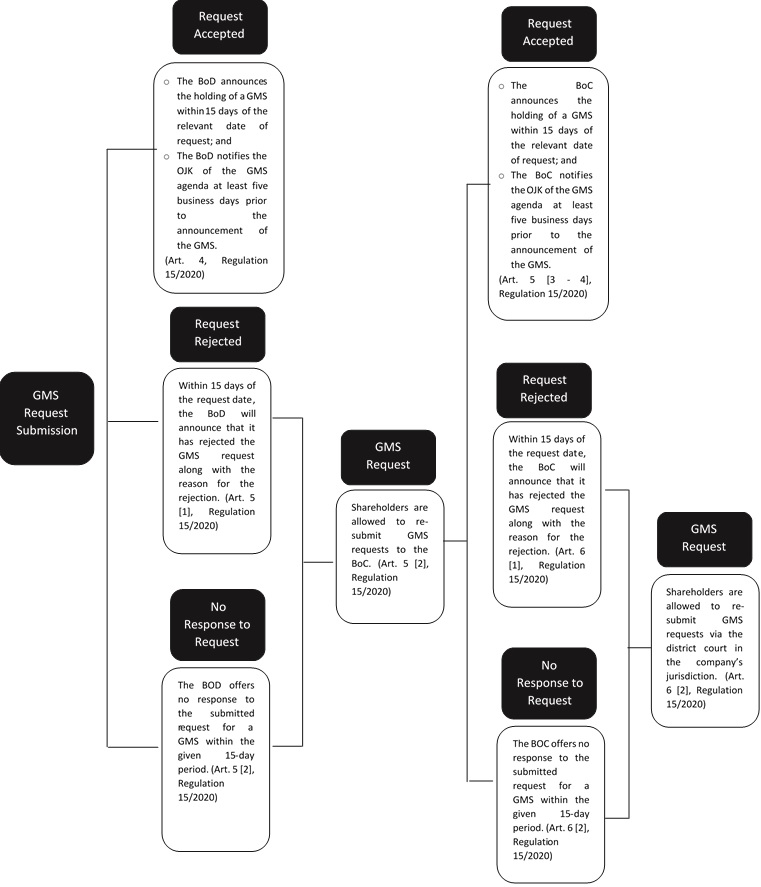
It is important to note that shareholders whose GMS requests are ultimately granted are prohibited from transferring their shares to any other parties within six months of the requested GMS being announced by the relevant BoD or BoC or being stipulated by a district court.[19]

Meanwhile, the procedure for the requesting of a GMS by a BoC is outlined in the flowchart below:
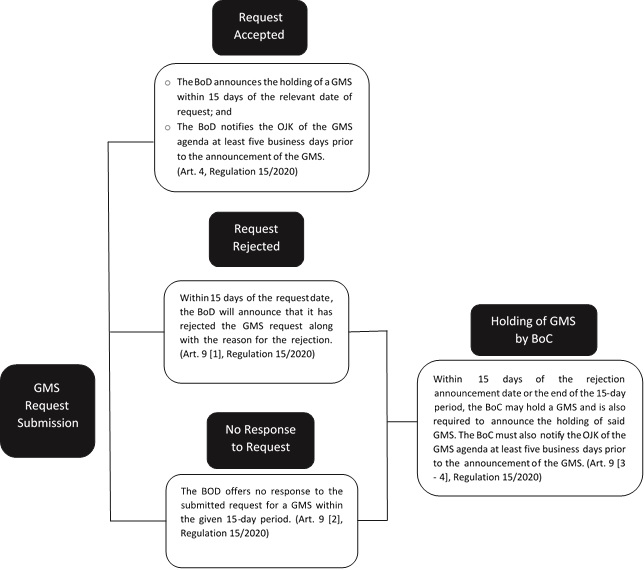

It is important to note that GMS which are held by BoC should aim to resolve the issues outlined in the relevant GMS request.[20]

The discussion outlined above shows that, while containing similar provisions to Regulation 32/2014, Regulation 15/2020 also clarifies that BoC are parties who may request GMS of Publicly-Traded Companies, as was originally intended under Law 40/2007.[21] This clarification broadens the authority of BoC which, under the previous framework of Regulation 32/2014, seemed to be somewhat limited as regards facilitating any shareholders whose requests to hold GMS were turned down by the relevant Boards of Directors.[22]


  1. GMS Procedures and Timeline

The overall procedure for the holding of a GMS is outlined in the flowchart below:
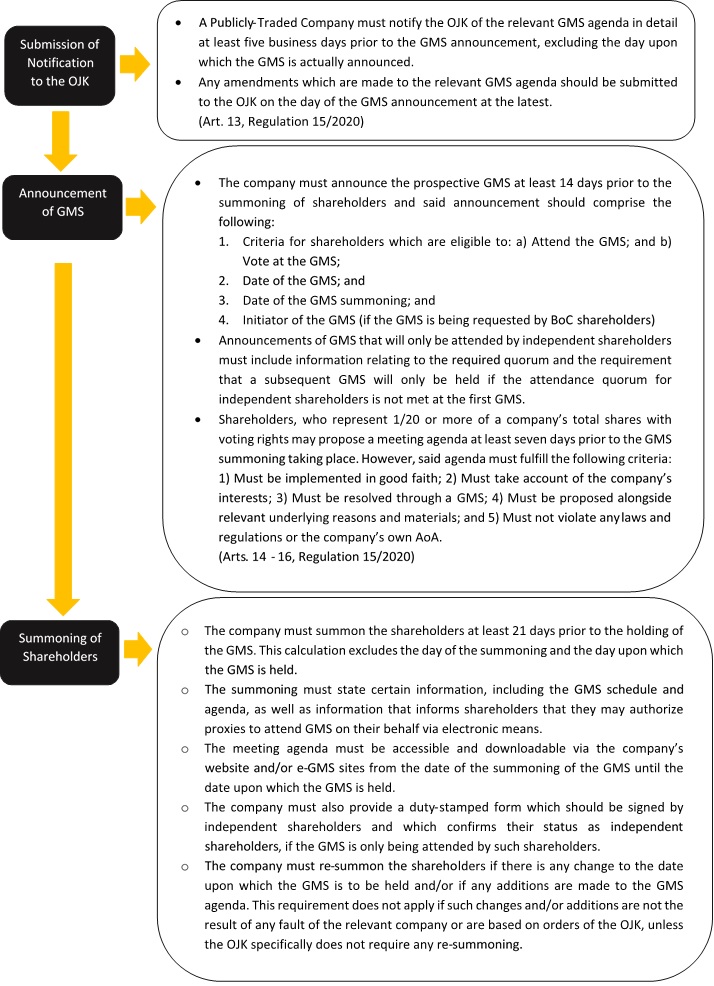
 

A  GMS must be held within Indonesian territory in accordance with a time and location[23] determined by the relevant Publicly-Traded Company.[24] The company’s shareholders may then attend the GMS by themselves or can be represented by proxies (who can now be authorized via electronic means),[25] provided that they have been incorporated onto the official list of company shareholders at least one business day prior to the GMS summoning or re-summoning (if applicable).[26]

If the relevant quorums (as discussed in an upcoming section) are not met,[27] then the relevant company may hold a second or third GMS under the conditions addressed in the following table:[28]

GMS Type

Required Period

Other Requirements

Eligible Attendees

to Hold the GMS

to Summon the Shareholders

Second GMS

Between 10 and 21 days after the first GMS is held

Seven days prior to the second GMS being held

The summons must state that the first GMS has been held but did not meet the required attendance quorum.

Shareholders who are included on the official list of company shareholders at least one business day prior to:

the summoning of the second GMS

Third GMS

The OJK will stipulate the relevant timeline after: 1) The company has submitted an application to hold a third GMS,[29] the submission of which must be completed within 14 days of the second GMS being held; and 2) The OJK has allowed for a third GMS to be held by the company in question.

the summoning of the third GMS


Upon holding a GMS, the Publicly-Traded Company in question must draw up an official set of GMS minutes and a summary. The minutes must be signed by the chairperson of the GMS and at least one of the shareholders appointed by the GMS unless the minutes are to be drawn up in notarial form by notaries registered with the OJK. This notarial form is mandatory for the minutes of any GMS which are only attended by independent shareholders.[30]

The minutes must then be submitted to the OJK within 30 days of the GMS being held. Meanwhile, the accompanying summary must be announced to the public within two business days of the relevant GMS being held.[31]

......

Subscribe to read more legal analysis.

Hukumonline Pro Intelligence

Platform AI hukum terpercaya sebagai solusi komprehensif riset Anda

professionalprofessionalProfessional Solutions
professionalprofessionalUniversity Solutions
*Syarat dan ketentuan berlaku

Overview

As mandated under Law No. 40 of 2007 on Limited Liability Companies (“Law 40/2007”), all limited liability companies are required to hold annual general meetings of shareholders (“GMS”) by no later than six months after the end of a given accounting year.[1] In order to comply with this requirement, issuers and public companies (collectively referred to as “Publicly-Traded Companies”) usually hold their GMS around April or May.[2]

However, as a result of the COVID-19 pandemic, many issuers had been planning to delay their GMS this year.[3] In response to the crisis, the Financial Services Authority (Otoritas Jasa Keuangan – “OJK”) issued Circular No. S-92/D.04/2020 on the Relaxation of the Submission of Reports and the Implementation of Mandatory General Meetings of Shareholders, which introduced an extension of two months for the holding of GMS by publicly-traded companies this year. As a result, the GMS deadline has now been moved from 30 June 2020 to 31 August 2020.[4]

In line with this relaxation, the OJK is hoping to optimize the utilization of technological advancements in an effort to further improve the efficiency and effectiveness of GMS, thus increasing shareholder participation in such meetings,[5] particularly during the implementation of physical distancing due to the COVID-19 pandemic. The OJK has therefore issued two regulations that set out various detailed provisions that specifically address the implementation of electronic GMS, as follows:

  1. Regulation of the OJK No. 15/POJK.04/2020 on the Planning and Organization of General Meetings of Shareholders by Publicly-Traded Companies (“Regulation 15/2020”),[6] which repeals and replaces Regulation of the OJK No. 32/POJK.04/2014, which bore the same title and which was amended through the issuance of Regulation of the OJK No. 10/POJK.04/2017 (collectively referred to as “Regulation 32/2014”);[7] and
  2. Regulation of the OJK No. 16/POJK.04/2020 on the Implementation of Electronic General Meetings of Shareholders by Publicly-Traded Companies (“Regulation 16/2020”).[8]


In order to provide an informative overview of the new regime for Publicly-Traded Company GMS, this edition of ILD will elaborate upon key aspects of both Regulation 15/2020 and Regulation 16/2020 and will specifically address the following areas:

  1. Planning and Organization of GMS in General
  1. GMS Types;
  2. GMS Requests;
  3. GMS Procedures and Timeline;
  4. GMS Quorums;
  5. GMS Announcements: Media and Language
  1. Electronic GMS
  1. Electronic GMS (“e-GMS”) Providers;
  2. Implementation of e-GMS;
  3. Authorization via e-GMS Systems;
  4. Voting via e-GMS Systems


  1. Planning and Organization of GMS in General

In order to achieve the overall objective of improving the efficiency and effectiveness of GMS held by Publicly-Traded Companies, Regulation 15/2020 revises the entire applicable regulatory framework, as previously set out under Regulation 32/2014. While covering provisions that address e-GMS, the updates outlined under Regulation 15/2020 also encompass provisions for the planning and organization of the GMS of Publicly-Traded Companies in general.[9] Said companies are also required to adjust their articles of association (“AoA”) to the provisions set out under Regulation 15/2020 within 18 months of this Regulation coming into force.[10]


  1.  GMS Types

In line with Law 40/2007, Regulation 15/2020 defines a GMS as an organ of a Publicly-Traded Company whose authorities are not granted to the company’s Board of Directors (“BoD”) or Board of Commissioners (“BoC”). These authorities must, however, be exercised in accordance with the limitations referred to under Law 40/2007 and/or under a given company’s articles of association.[11]

As also outlined under Law 40/2007, Regulation 15/2020 acknowledges two types of GMS which can be held by Publicly-Traded Companies: annual GMS and extraordinary GMS. While extraordinary GMS may be held at any time deemed necessary, an annual GMS must be held within six months of the end of a given accounting year.[12]

However, Regulation 15/2020 further elaborates that the OJK may now stipulate other deadlines for the organization of annual GMS in certain circumstances, such as during significantly fluctuating market conditions.[13] This provision was not previously addressed under Regulation 32/2014.[14]


  1. GMS Requests

In essence, the BoD of a Publicly-Traded Company is required to hold mandatory annual GMS.[15] However, such companies may also hold GMS at the request of the following parties:[16]

  1. One or more shareholders who represent 1/10 or more of the total amount of shares with voting rights, unless stipulated otherwise under the company’s AoA; or
  2. The company’s BoC.


All such requests should be submitted to the relevant BoD, stipulating the underlying reasons behind said requests.[17] In addition, copies of such shareholder requests should be delivered to the relevant BoC.[18]

The procedure which should be followed by any shareholders who want to request GMS is outlined in the flowchart below:

It is important to note that shareholders whose GMS requests are ultimately granted are prohibited from transferring their shares to any other parties within six months of the requested GMS being announced by the relevant BoD or BoC or being stipulated by a district court.[19]

Meanwhile, the procedure for the requesting of a GMS by a BoC is outlined in the flowchart below:


It is important to note that GMS which are held by BoC should aim to resolve the issues outlined in the relevant GMS request.[20]

The discussion outlined above shows that, while containing similar provisions to Regulation 32/2014, Regulation 15/2020 also clarifies that BoC are parties who may request GMS of Publicly-Traded Companies, as was originally intended under Law 40/2007.[21] This clarification broadens the authority of BoC which, under the previous framework of Regulation 32/2014, seemed to be somewhat limited as regards facilitating any shareholders whose requests to hold GMS were turned down by the relevant Boards of Directors.[22]


  1. GMS Procedures and Timeline

The overall procedure for the holding of a GMS is outlined in the flowchart below:


A  GMS must be held within Indonesian territory in accordance with a time and location[23] determined by the relevant Publicly-Traded Company.[24] The company’s shareholders may then attend the GMS by themselves or can be represented by proxies (who can now be authorized via electronic means),[25] provided that they have been incorporated onto the official list of company shareholders at least one business day prior to the GMS summoning or re-summoning (if applicable).[26]

If the relevant quorums (as discussed in an upcoming section) are not met,[27] then the relevant company may hold a second or third GMS under the conditions addressed in the following table:[28]

GMS Type

Required Period

Other Requirements

Eligible Attendees

to Hold the GMS

to Summon the Shareholders

Second GMS

Between 10 and 21 days after the first GMS is held

Seven days prior to the second GMS being held

The summons must state that the first GMS has been held but did not meet the required attendance quorum.

Shareholders who are included on the official list of company shareholders at least one business day prior to:

the summoning of the second GMS

Third GMS

The OJK will stipulate the relevant timeline after: 1) The company has submitted an application to hold a third GMS,[29] the submission of which must be completed within 14 days of the second GMS being held; and 2) The OJK has allowed for a third GMS to be held by the company in question.

the summoning of the third GMS


Upon holding a GMS, the Publicly-Traded Company in question must draw up an official set of GMS minutes and a summary. The minutes must be signed by the chairperson of the GMS and at least one of the shareholders appointed by the GMS unless the minutes are to be drawn up in notarial form by notaries registered with the OJK. This notarial form is mandatory for the minutes of any GMS which are only attended by independent shareholders.[30]

The minutes must then be submitted to the OJK within 30 days of the GMS being held. Meanwhile, the accompanying summary must be announced to the public within two business days of the relevant GMS being held.[31]

......

Subscribe to read more legal analysis.

Hukumonline Pro Intelligence

Platform AI hukum terpercaya sebagai solusi komprehensif riset Anda

professionalprofessionalProfessional Solutions
professionalprofessionalUniversity Solutions
*Syarat dan ketentuan berlaku
2026 Hak Cipta Milik Hukumonline.com
Cookies Info

