Overview
In essence, share buybacks comprise a mechanism through which companies can repurchase various amounts of their outstanding shares. This mechanism can be utilized by either public or private companies for various purposes and can be implemented on either a voluntary or a mandatory basis, depending on the relevant context.
As the primary regulatory framework for share buybacks, Law No. 40 of 2007 on Limited Liability Companies (“Company Law”) states that share buybacks are mandatory when they are requested by company shareholders who express their opposition to any of the following corporate actions:[1]
- Amendments which are made to a company’s articles of association (“AoA”);
- Transfers or encumbrance of company assets which are worth more than 50% of a company’s net assets; or
- Mergers, consolidations, acquisitions and spin-offs.
Share buybacks that are undertaken for any purposes other than the above can be carried out on a voluntary basis. Share buybacks are usually undertaken for commercial purposes, including increasing the value of the relevant shares.[2]
Regardless of the underlying motives, share buybacks must be carried out in accordance with the relevant applicable laws and regulations. As mentioned above, the main legal framework which addresses share buybacks is the Company Law. However, share buybacks which are carried out by public companies are also subject to a number of additional requirements which are set out under the following Regulations of the Financial Services Authority (Otoritas Jasa Keuangan – “OJK”):
- Regulation of the OJK No. 2/POJK.04/2013 on Buybacks of Shares Issued by Issuers or Public Companies during Significantly Fluctuating Market Conditions (“Regulation 2/2013”);[3] and
- Regulation of the OJK No. 30/POJK.04/2017 on Buybacks of Shares Issued by Public Companies (“Regulation 30/2017”).[4]
This edition of Indonesian Law Digest (ILD) will discuss the requirements and procedures which have to be complied with by both public and private companies when they carry out any share buybacks. Our discussion breaks down as follows:
- Share Buybacks Undertaken by Private Companies:
- Requirements;
- Procedure;
- Redistribution of Treasury Shares;
- Share Buybacks Undertaken by Public Companies:
- Buybacks Undertaken during Normal Market Conditions:
- General Meetings of Shareholders (“GMS”)
- Information Disclosure;
- Implementation of Buybacks;
- Redistribution of Treasury Shares;
- Sales of Treasury Shares;
- Insider Trading;
- Share Buybacks Undertaken During Significantly Fluctuating Market Conditions:
- Information Disclosure;
- Implementation of Buybacks;
- Redistribution of Treasury Shares;
- Sales of Treasury Shares;
- Insider Trading;
- Transactions Timelines.
- Share Buybacks Undertaken by Private Companies
Generally speaking, the basic requirements and procedures which address share buybacks are regulated under the Company Law. These requirements and procedures apply to both public and private companies. However, in contrast with public companies, private companies are not subject to any of the additional requirements which are set out under other regulations, including a number of official Regulations of the OJK. This means that the requirements and procedures which apply to share buybacks undertaken by private companies are entirely regulated under the Company Law.
- Requirements
The Company Law requires all limited-liability companies which are aiming to complete share buybacks, whether on a voluntary or mandatory basis, to comply with the following requirements:[5]
- Share buybacks must not result in a company’s net assets[6] falling to levels below that of the company’s issued capital and allocated mandatory reserves; and
- The total nominal value of all shares which are bought back by a company and all pledges or fiduciary securities relating to shares held by the company itself and/or other companies whose shares are directly or indirectly owned by the company, should not exceed 10% of the company’s issued capital, unless specifically addressed under the relevant applicable capital-market laws and regulations.
Share buybacks that do not meet the abovementioned requirements will be declared null and void. Moreover, any losses which result from said null-and-void share buybacks will become the joint responsibility of the relevant company’s Board of Directors (“BoD”).[7]
- Procedure
The overall procedure for share buybacks which are undertaken by private companies is described in the flowchart below:
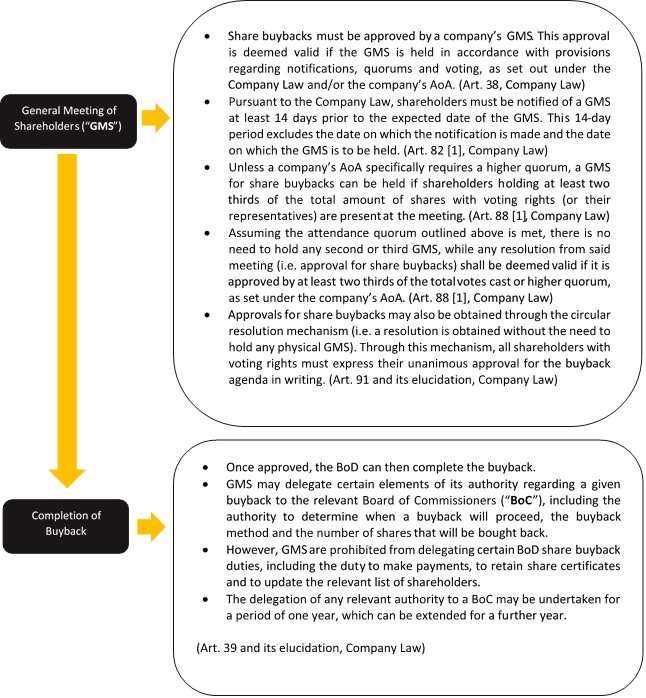
Based on a recent discussion between Hukum Online and a prominent notary, any GMS which is held in order to resolve a corporate action (e.g. a merger, consolidation or acquisition) can also simultaneously render approval for a share buyback.
- Redistribution of Treasury Shares
Treasury shares (i.e. shares which are repurchased by a company) may only remain in the relevant company’s possession for three years at the maximum.[8] While they are in the possession of the company, the shares resulting from a buyback cannot be used in order to cast votes and will not be counted when determining any GMS quorums. In addition, such shares are also not entitled to receive any distributed dividends.[9]
After the abovementioned period has ended, the shares in question must either be sold to other parties or withdrawn by the company. If they are withdrawn, then the company must reduce its capital.[10] However, this capital reduction can only be carried out after it has been officially approved through a GMS.[11]
As additional information, a company may also opt to implement an employee/management stock program in order to release any bought back shares from its possession.[12]
- Share Buybacks Undertaken by Public Companies
As outlined above, share buybacks undertaken by public companies are subject to a number of additional requirements that can be found set out under Regulation 30/2017 and Regulation 3/2013. While Regulation 30/2017 outlines requirements for buybacks that are undertaken during normal market conditions, Regulation 3/2013 outlines requirements for buybacks that are undertaken during periods of significant market fluctuations.
However, both Regulation 30/2017 and Regulation 3/2013 state that all share buybacks which are undertaken by public companies must not violate any of the following prohibitions, as set out under Law No. 8 of 1995 on the Capital Market (“Capital-Market Law”):[13]
- Prohibition on disseminating any misleading information relating to trading activities, market conditions and share prices at the stock exchange;
- Prohibition on maintaining, increasing or decreasing share prices in order to influence other parties to purchase, sell or retain shares; and
- Prohibition on insider trading.
- Buybacks Undertaken during Normal Market Conditions
In general, public companies aiming to complete share buybacks must comply with the various requirements which are set out under the Company Law, as discussed in Section I.A of this edition of ILD.[14] However, Regulation 30/2017 goes on to set out a number of additional requirements which have to be met by public companies in relation to the following matters:
- GMS;
- Information disclosure;
- Implementation of share buybacks;
- Release of treasury shares;
- Sales of treasury shares; and
- Insider trading.
- GMS
In a manner similar to the Company Law, Regulation 30/2017 also requires public companies to obtain approvals through their GMS prior to completing any share buybacks. However, the various requirements and procedures which have to be met by public companies when holding any GMS are set out under Regulation of the OJK No. 32/POJK.04/2014 on the Planning and Holding of General Meetings of Shareholders by Public Companies, as amended by Regulation of the OJK No. 10/POJK.04/2017 (collectively referred to as “Regulation 32/2014”) [15]
- Information Disclosure
As well as announcing GMS, any public companies which are aiming to buy back their shares must simultaneously disclose the following information to their shareholders:[16]
- Estimation of schedules, estimation of the cost of the share buyback and estimation of the total nominal value of all shares which will be repurchased;
- Explanation, consideration and underlying cause for the buyback of public company shares;
- Estimation of the decline in the revenue of the relevant public company as a result of the undertaking of share buybacks and its impact upon the financing costs of the public company;
- Performa earning of public company shares after the completion of the relevant share buyback, with due consideration being paid to any decline in revenue;
- Share price limitation for the share buyback;
- Timeframe limitation for the share buyback;
- Methods which will be employed to buy back the shares; and
- Management discussion and analysis as regards the impact of the share buyback upon business activities and upon the growth of the public company in the future.
Any amendments or supplements which are made to the disclosed information outlined above must also be publicly announced. Announcements must be made at least two business days prior to the holding of any GMS.[17]
Moreover, evidence of any such announcements must be submitted to the OJK within two business days of the relevant announcement being made.[18]
It should be noted that any public companies which are aiming to complete share buybacks for mandatory reasons (e.g. mergers, consolidations, acquisitions) must also announce the following information to the public and also disclose said information to the OJK:[19]
- Reason for the buyback of public company shares;
- Identities of any shareholders whose shares can be repurchased by public companies;
- Share price and procedure for determining said price; and
- Timeframe for the completion of share buybacks.
In this case, announcements and information disclosures must be completed by no later than two days after the holding of any GMS that approves the underlying corporate action.[20]
- Implementation of Buybacks
Public companies must execute share buybacks within 18 months of any such buyback being approved through a GMS.[21] Buybacks can be completed in two ways, as detailed in the table below:
|
Method[22]
|
Requirements
|
|
Through the stock exchange[23]
|
- Purchase transactions are to be carried out through 1 (one) Stock Exchange Member; and
- The bid price (harga penawaran) for the repurchase of shares should be lower than or equal to the price of the previous transaction
|
|
Outside the stock exchange[24]
|
If shares are listed on and traded through the stock exchange
|
The highest buyback price is the average daily close-of-trade price at the stock exchange during the 90 days prior to the buyback date
|
|
If shares are not listed on the stock exchange
|
The highest buyback price is the fair market price, as determined by an appraiser
|
|
If shares are listed on the stock exchange but have not been traded or have been subject to trading suspensions at the stock exchange for 90 days or more prior to the relevant buyback date
|
The highest buyback price is the lowest of the following two prices:
- The fair market price, as determined by an appraiser; or
- The average daily close-of-trade price at the stock exchange during the 12 months since the public company’s last trading day at the stock exchange.
|
However, any public companies whose shares are listed at the stock exchange are prohibited from repurchasing shares if any such repurchase will result in any significant decrease in the overall number of shares and thus affect share liquidity at the stock exchange.[25]
It should also be noted that public companies must report the results of their share buybacks to the OJK on a six-monthly basis, specifically in June and December. The final submission dates for these reports are 15 July and 15 January.[26]
- Redistribution of Treasury Shares
Regulation 30/2017 requires public companies to redistribute their treasury shares through the following measures:[27]
- Sales through the stock exchange or external to the stock exchange;
- Withdrawal through a capital reduction mechanism;
- Employee/management stock option program;
- Debt-to-equity conversion; and/or
- Other measures approved by the OJK.
The various redistribution measures which are outlined above should be completed within a six-year period as follows:[28]
- Three years from the completion of any buyback transactions;
- Two years from the end of the first three-year period in order to continue the redistribution of the treasury shares; and
- One year from the end of the abovementioned two-year period in order to complete the transfer of all of the relevant treasury shares.
However, the mandated period for sales of treasury shares (either through the stock exchange or not) may be postponed under the following circumstances:[29]
- The Indonesia composite index (indeks harga saham gabungan – “IHSG”) at the stock exchange drops by more than 10% from the IHSG that was posted during the previous one exchange day (hari bursa) for a period of three consecutive exchange days;
- The stock exchange through which the shares are listed goes out of business;
- The trading of the shares in question through the stock exchange is terminated; and/or
- Natural disasters, wars, riots, conflagrations and/or employee strikes (pemogokan) occur which significantly affect the continuity of the public company’s business activities.
If said circumstances no longer apply, then public companies should revert to the original timeframe for the redistribution of treasury shares.[30]
- Sales of Treasury Shares
Public companies which redistribute treasury shares through the selling method must meet the following requirements:[31]
- Redistributions must only be carried out after 30 days have elapsed since the completion of the relevant buyback;
- Redistributions must not be carried out within the same period as the period of the buyback transactions; and
- Companies must ensure that the selling price of the treasury shares is not lower than the average buyback price and must also observe the following price floor threshold criteria:
|
Share Type
|
Price Floor Threshold
|
|
Shares that are listed on and traded through the stock exchange
|
Whichever is the higher from the following:
- The daily close-of-trade price on the stock exchange one exchange day prior to the sale taking place; or
- The average daily close-of-trade price on the stock exchange during the 90 days prior to the sale taking place
|
|
Shares that are not listed on the stock exchange
|
A fair market price, as determined by an appraiser
|
|
Shares that are listed on the stock exchange but that have not been traded or have been subject to trading suspensions at the stock exchange for 90 days or more prior to the date upon which the sale takes place
|
Whichever is the higher from the following:
- The daily close-of-trade price on the stock exchange one exchange day prior to the sale taking place; or
- The average daily close-of-trade price on the stock exchange during the 12 months prior to the final trading day for such shares on the stock exchange
|
- Any losses which are incurred due to sales of treasury shares at prices that are lower than the relevant buyback price must be reported.
It should also be noted that sales of treasury shares undertaken by public companies can be carried out without the need to obtain any prior approval via a company GMS.[32] However, by no later than 14 days prior to the date upon which the relevant sale will take place, the company must still announce information which addresses the sale of the treasury shares to the general public and must submit evidence of any such announcement to the OJK.[33]
The scope of information that must be announced depends on the relevant selling channels, as detailed in the table below:[34]
|
Outside the Stock Exchange
|
Through the Stock Exchange
|
- Identities of the buyers;
- The period during which the sale will take place;
- The business activities of the buyers, if they are not business entities; and
- Any affiliation between buyers and sellers (i.e. the public companies)
|
- Name of the stock-exchange member who has been appointed to carry out the sale;
- The period during which the sale will take place; and
- The total number of shares that will be sold
|
Moreover, all sales of treasury shares which are completed through the stock exchange are also subject to the following additional requirements:[35]
- Sales are only to be carried out through one stock-exchange member;
- Sales can only be carried out 30 minutes after the opening of trade until 30 minutes prior to the close of trade; and
- The number of treasury shares that can be sold on a daily basis is set at a maximum of 20% of the total number of shares that have been repurchased by public companies.
iv. Insider Trading
Certain parties are prohibited from carrying out any transactions involving public company shares which have undergone a buyback process on the same day upon which the relevant buyback has taken place or upon which the sale of the treasury shares has taken place. These parties break down as follows:[36]
- Members of the BoC or BoD, employees and ultimate shareholders of the public company;
- Individuals who are able to obtain inside information due to their positions or professions or business relations with the public company; and
- Parties that were defined as any of the parties outlined in part (a) or part (b) above during the previous six months but which are no longer defined as such.
- Share Buybacks Undertaken during Significantly Fluctuating Market Conditions
A significant market fluctuation is a condition which involves a cumulative IHSG decline of at least 15% at the stock exchange over a period of three consecutive exchange days, or other conditions, as stipulated by the OJK.[37] Buybacks which are undertaken during any periods of significant market fluctuation are subject to a number of additional requirements, as set out under Regulation 3/2013, which specifically addresses the following matters:
- Information disclosure;
- Redistribution of treasury shares;
- Sales of treasury shares; and
- Insider trading
- Information Disclosure
Any public company aiming to carry out a share buyback during a period of significant market fluctuation is not required to obtain prior approval through a GMS.[38] However, said company must still provide the following information to the OJK and the stock exchange for the purposes of information transparency:[39]
- Estimation of schedules, estimation of the cost of the share buyback and estimation of the total nominal value of all shares which will be repurchased;
- Estimation of the decline in the revenue of the relevant public company as a result of the undertaking of share buybacks and its impact upon the financing costs of the public company;
- Performa earning of public company shares after the completion of the relevant share buyback, with due consideration being paid to any decline in revenue;
- Share price limitation for the share buyback;
- Timeframe limitation for the share buyback;
- Methods which will be employed to buy back the shares; and
- Management discussion and analysis as regards the impact of the share buyback upon business activities and upon the growth of the public company in the future.
Said information must be submitted within seven exchange days of the completion of the significant market fluctuation in question.[40]
- Implementation of Buybacks
Buybacks may be implemented from the time that a public company submits the required information outlined above to the OJK and to the stock exchange for up to three months afterwards. During this buyback period, a public company may only repurchase a maximum of 20% of its paid-up capital while the relevant repurchase transactions must be granted assistance by one stock exchange member only (if the relevant buyback is being completed through the stock exchange).[41]
- Redistribution of Treasury Shares
In a manner similar to Regulation 3o/2017, Regulation 2/2013 also requires public companies to complete the redistribution of treasury shares within a period of six years. However, this period may be extended due to the occurrence of any conditions which are defined as significant market fluctuations, provided that public companies revert to the original timeframe once said fluctuations end.[42]
During the period outlined above, public companies must redistribute their treasury shares through the following methods:[43]
- Sales through the stock exchange or outside the stock exchange;
- Withdrawals through a capital reduction mechanism;
- Employee/management stock-option program;
- Debt-to-equity conversion; and/or
- Warrants execution.
- Sales of Treasury Shares
Public companies can only sell their treasury shares:[44]
- 30 days after the full completion of the relevant buyback; or
- Three months after the end of the relevant buyback period.
The selling price for treasury shares must not be lower than the following:[45]
|
Share Type
|
Price Floor Threshold
|
|
Shares that are listed on and traded through the stock exchange
|
Whichever is the higher from the following:
- The daily close-of-trade price on the stock exchange one exchange day prior to the sale taking place; or
- The average daily close-of-trade price on the stock exchange during the 90 days prior to the sale taking place
|
|
Shares that are not listed on the stock exchange
|
A fair market price, as determined by an appraiser
|
|
Shares that are listed on the stock exchange but that have not been traded or have been subject to trading suspensions at the stock exchange for 90 days or more prior to the date upon which the sale takes place
|
Whichever is the higher from the following:
- A fair market price, as determined by an appraiser; or
- The average daily close-of-trade price on the stock exchange during the 12 months prior to the final trading day for such shares on the stock exchange
|
In a manner similar to Regulation 30/2017, sales of the treasury shares under Regulation 2/2013 are also subject to various information transparency requirements, as outlined in Section II.A.ii of this edition of ILD.[46]
However, it is important to note that Regulation 2/2013 does not specifically prohibit public companies from selling any treasury shares during the buyback period, as is the case under Regulation 30/2017. Moreover, it can even be argued that Regulation 2/2013 allows public companies to re-sell their treasury shares during the period in which they are actually completing buybacks.
- Insider Trading
Regulation 2/2013 also prohibits certain parties related to a public company from undertaking any transactions which involve the company’s shares during the buyback period or on the same day when the sale of the treasury shares through the stock exchange takes place. These parties are discussed under Section II.A.vi of this edition of ILD.[47]
- Transaction Timeline

......



 Ada Pertanyaan? Hubungi Kami




 Professional Solutions

 University Solutions
 Pro
 My Workspace
 Pro AI
 Terfavorit


 Allex QnA
 Pro Compliance

