


 Ada Pertanyaan? Hubungi Kami


2026 Hak Cipta Milik Hukumonline.com
Produk Pilihan


 Ada Pertanyaan? Hubungi Kami
Marcell Sihombing, Rofiq Hidayat
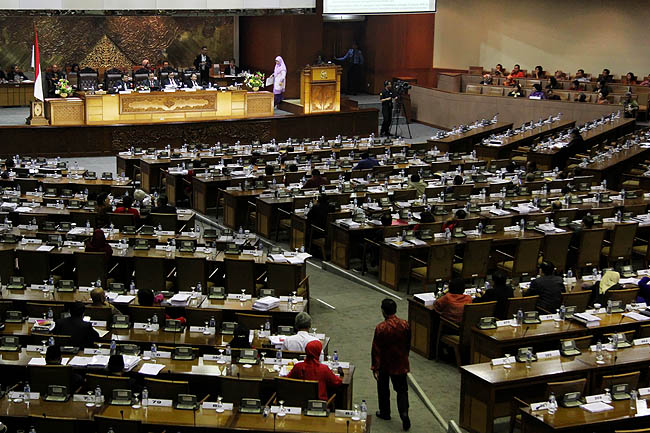
House of Representatives' Plenary Session. Photo by: RES.
The House of Representatives (House) has finally passed the Draft Bill on Tax Amnesty (Tax-Amnesty Bill) into law during a plenary session (rapat paripurna) which was led by House Speaker, Ade Komarudin, on Tuesday, 28 June 2016. However, the decision was accompanied by demands for revisions from several factions.
Commenting on the passage of the Tax-Amnesty Bill, lawmaker Ahmadi Noor Supit, Chair of House Commission XI, stated in his final report that each faction had already filed several motions during the bill’s deliberation stages and first decision-making stage. Mr. Supit further emphasized that these motions were an inseparable part of the second decision-making stage and, ultimately, of the passage of the bill).
Mr. Supit further explained that the Tax Amnesty Bill outlined a number of key points and ideas in its 13 Chapters and 25 Articles. Firstly, the tax amnesty nullifies a taxpayer’s tax arrears, which comprise of income tax (PPh), value-added tax (PPn), and luxury-goods sales tax (PPnBM). The Bill also waives tax administration and penal sanctions. Secondly, each and every taxpayer will be entitled to enjoy a tax amnesty.
Thirdly, the penalty rate for repatriated assets or declared domestic assets is to be set at 2% during the first three months of the bill’s effective enforcement, 3% during the second three months, and 5% from 1 January 2017 to 31 March 2017. Moreover, the penalty rate for declared foreign assets will be set at 4% during the first three months, 6% during the second three months, and 10% from 1 January 2017 to 31 March 2017. Meanwhile, micro-, small- and medium-scale businesses (UMKM) who voluntarily declare their obligations for amounts of up to IDR 10 billion will only have to pay a 0.5% penalty rate, while taxpayers who voluntarily declare any amount over IDR 10 billion on their declaration forms on 31 March 2017 will only have to pay a 2% penalty rate.
Mr. Supit also explained that the working committee (panitia kerja) for the new Tax-Amnesty Bill had decided to divide the submission timeframe for the above declarations into a first period comprising of the first three months after the effective enforcement of this bill, a second period running from the fourth month to 31 December 2016, and a third period running from 1 January 2017 to 31 March 2017.
Fourthly, the bill stipulates that the repatriation of assets from foreign countries to Indonesia must be undertaken through banks appointed by the Minister of Finance. Such assets must be invested back into Indonesia by 31 December 2016 at the latest by taxpayers who declare their assets during the first or second of the three periods described above, while taxpayers who declare their assets during the third period have until 31 March 2017 in which to do so.
Fifthly, all data and information contained in any submitted affidavit and its attached documents which are managed by the Ministry of Finance cannot then become the basis upon which any preliminary inquiries (penyelidikan), investigations (penyidikan), or criminal prosecutions of taxpayers can occur. Moreover, any parties involved in the implementation of the tax amnesty are prohibited from disseminating any relevant information to any other party or parties.
“Any violations regarding this provision will be subject to the maximum penalty allowed by law,” asserted Mr. Supit.
Indonesia’s Minister of Finance, Bambang Brodjonegoro, has stated his belief that the tax amnesty represented just one among many possible ways of optimizing the Indonesian economy. Minister Brodjonegoro is also convinced that in spite of the current slowdown in economic growth, the Draft Bill will eventually allow the Indonesian economy to fulfill its maximum potential.
Minister Brodjonegoro bases this belief on the fact that Indonesia’s financial liquidity will be greatly improved if the assumed substantial amounts of taxpayer assets currently parked in other countries can ultimately be repatriated back to Indonesia. The Minister is confident that such assets, which of course have not yet been subject to taxation, will greatly increase the state budget, as well as the country’s financial liquidity as a whole.
Tax Amnesty Bill Challenged
In opposition to other house factions, the Prosperous Justice Party (Partai Keadilan Sejahtera - PKS) faction has challenged the passage of the Tax-Amnesty Bill. Indeed, the PKS faction is asserting that several provisions set out in the bill violate the fairness principle, specifically as it applies to law-abiding taxpayers.
By way of example, lawmaker Ecky Awal Mucharam, a Commission XI member from the PKS faction, pointed to the various tax-amnesty objects which are stipulated under the Tax-Amnesty Bill. According to Article 3 of the bill, the tax amnesty applies to income tax (PPh), PPn, and PPnBM. This runs contrary to common practice, whereby tax amnesties are usually only granted to income tax. The PKS faction is insisting that any tax-amnesty policy should apply to income tax only. Furthermore, the PKS faction asserts that only administrative and criminal sanctions that should be nullified under the bill, and therefore that any outstanding income-tax arrears must still be paid.
Secondly, Mr. Mucharam points to Article 4 of the Tax Amnesty Bill, which regulates penalty rates and facilities. Mr. Mucharam asserts that this particular article makes it seem as if the government has been quick to grant low penalty rates. The government is thus losing a great amount of revenue, Mr. Mucharam believes, and is therefore violating the fairness principle.
Commenting on the passage of the Tax-Amnesty Bill, lawmaker Ahmadi Noor Supit, Chair of House Commission XI, stated in his final report that each faction had already filed several motions during the bill’s deliberation stages and first decision-making stage. Mr. Supit further emphasized that these motions were an inseparable part of the second decision-making stage and, ultimately, of the passage of the bill).
Mr. Supit further explained that the Tax Amnesty Bill outlined a number of key points and ideas in its 13 Chapters and 25 Articles. Firstly, the tax amnesty nullifies a taxpayer’s tax arrears, which comprise of income tax (PPh), value-added tax (PPn), and luxury-goods sales tax (PPnBM). The Bill also waives tax administration and penal sanctions. Secondly, each and every taxpayer will be entitled to enjoy a tax amnesty.
Thirdly, the penalty rate for repatriated assets or declared domestic assets is to be set at 2% during the first three months of the bill’s effective enforcement, 3% during the second three months, and 5% from 1 January 2017 to 31 March 2017. Moreover, the penalty rate for declared foreign assets will be set at 4% during the first three months, 6% during the second three months, and 10% from 1 January 2017 to 31 March 2017. Meanwhile, micro-, small- and medium-scale businesses (UMKM) who voluntarily declare their obligations for amounts of up to IDR 10 billion will only have to pay a 0.5% penalty rate, while taxpayers who voluntarily declare any amount over IDR 10 billion on their declaration forms on 31 March 2017 will only have to pay a 2% penalty rate.
Mr. Supit also explained that the working committee (panitia kerja) for the new Tax-Amnesty Bill had decided to divide the submission timeframe for the above declarations into a first period comprising of the first three months after the effective enforcement of this bill, a second period running from the fourth month to 31 December 2016, and a third period running from 1 January 2017 to 31 March 2017.
Fourthly, the bill stipulates that the repatriation of assets from foreign countries to Indonesia must be undertaken through banks appointed by the Minister of Finance. Such assets must be invested back into Indonesia by 31 December 2016 at the latest by taxpayers who declare their assets during the first or second of the three periods described above, while taxpayers who declare their assets during the third period have until 31 March 2017 in which to do so.
Fifthly, all data and information contained in any submitted affidavit and its attached documents which are managed by the Ministry of Finance cannot then become the basis upon which any preliminary inquiries (penyelidikan), investigations (penyidikan), or criminal prosecutions of taxpayers can occur. Moreover, any parties involved in the implementation of the tax amnesty are prohibited from disseminating any relevant information to any other party or parties.
“Any violations regarding this provision will be subject to the maximum penalty allowed by law,” asserted Mr. Supit.
Indonesia’s Minister of Finance, Bambang Brodjonegoro, has stated his belief that the tax amnesty represented just one among many possible ways of optimizing the Indonesian economy. Minister Brodjonegoro is also convinced that in spite of the current slowdown in economic growth, the Draft Bill will eventually allow the Indonesian economy to fulfill its maximum potential.
Minister Brodjonegoro bases this belief on the fact that Indonesia’s financial liquidity will be greatly improved if the assumed substantial amounts of taxpayer assets currently parked in other countries can ultimately be repatriated back to Indonesia. The Minister is confident that such assets, which of course have not yet been subject to taxation, will greatly increase the state budget, as well as the country’s financial liquidity as a whole.
Tax Amnesty Bill Challenged
In opposition to other house factions, the Prosperous Justice Party (Partai Keadilan Sejahtera - PKS) faction has challenged the passage of the Tax-Amnesty Bill. Indeed, the PKS faction is asserting that several provisions set out in the bill violate the fairness principle, specifically as it applies to law-abiding taxpayers.
By way of example, lawmaker Ecky Awal Mucharam, a Commission XI member from the PKS faction, pointed to the various tax-amnesty objects which are stipulated under the Tax-Amnesty Bill. According to Article 3 of the bill, the tax amnesty applies to income tax (PPh), PPn, and PPnBM. This runs contrary to common practice, whereby tax amnesties are usually only granted to income tax. The PKS faction is insisting that any tax-amnesty policy should apply to income tax only. Furthermore, the PKS faction asserts that only administrative and criminal sanctions that should be nullified under the bill, and therefore that any outstanding income-tax arrears must still be paid.
Secondly, Mr. Mucharam points to Article 4 of the Tax Amnesty Bill, which regulates penalty rates and facilities. Mr. Mucharam asserts that this particular article makes it seem as if the government has been quick to grant low penalty rates. The government is thus losing a great amount of revenue, Mr. Mucharam believes, and is therefore violating the fairness principle.
“In order to prevent a major loss of revenue and also to uphold the fairness principle, the tax-amnesty facility should be limited to administrative and criminal sanctions only. However, tax-amnesty participants should still ultimately pay their tax arrears,” Mr. Mucharam asserted.
Thirdly, Mr. Mucharam also criticized the provision pertaining to information and data contained within the affidavit, as stipulated under Article 20 of the Tax-Amnesty Bill, which prohibits the use of such data as a basis for any preliminary inquiries (penyelidikan), investigations (penyidikan), or criminal prosecutions of taxpayers. Mr. Mucharam firmly believes that this provision will be prone to misappropriation and also offers another chance for corruption, drug-dealing, money laundering, and human trafficking crimes to flourish.
“The PKS faction believes that Article 20 of the Tax-Amnesty Bill should be better reinforced and formulated under a [separate] data confidentiality provision,” Mr. Mucharam concluded.
Thirdly, Mr. Mucharam also criticized the provision pertaining to information and data contained within the affidavit, as stipulated under Article 20 of the Tax-Amnesty Bill, which prohibits the use of such data as a basis for any preliminary inquiries (penyelidikan), investigations (penyidikan), or criminal prosecutions of taxpayers. Mr. Mucharam firmly believes that this provision will be prone to misappropriation and also offers another chance for corruption, drug-dealing, money laundering, and human trafficking crimes to flourish.
“The PKS faction believes that Article 20 of the Tax-Amnesty Bill should be better reinforced and formulated under a [separate] data confidentiality provision,” Mr. Mucharam concluded.
(hs/sp)
Marcell Sihombing, Rofiq Hidayat
House of Representatives' Plenary Session. Photo by: RES.
The House of Representatives (House) has finally passed the Draft Bill on Tax Amnesty (Tax-Amnesty Bill) into law during a plenary session (rapat paripurna) which was led by House Speaker, Ade Komarudin, on Tuesday, 28 June 2016. However, the decision was accompanied by demands for revisions from several factions.
Commenting on the passage of the Tax-Amnesty Bill, lawmaker Ahmadi Noor Supit, Chair of House Commission XI, stated in his final report that each faction had already filed several motions during the bill’s deliberation stages and first decision-making stage. Mr. Supit further emphasized that these motions were an inseparable part of the second decision-making stage and, ultimately, of the passage of the bill).
Mr. Supit further explained that the Tax Amnesty Bill outlined a number of key points and ideas in its 13 Chapters and 25 Articles. Firstly, the tax amnesty nullifies a taxpayer’s tax arrears, which comprise of income tax (PPh), value-added tax (PPn), and luxury-goods sales tax (PPnBM). The Bill also waives tax administration and penal sanctions. Secondly, each and every taxpayer will be entitled to enjoy a tax amnesty.
Thirdly, the penalty rate for repatriated assets or declared domestic assets is to be set at 2% during the first three months of the bill’s effective enforcement, 3% during the second three months, and 5% from 1 January 2017 to 31 March 2017. Moreover, the penalty rate for declared foreign assets will be set at 4% during the first three months, 6% during the second three months, and 10% from 1 January 2017 to 31 March 2017. Meanwhile, micro-, small- and medium-scale businesses (UMKM) who voluntarily declare their obligations for amounts of up to IDR 10 billion will only have to pay a 0.5% penalty rate, while taxpayers who voluntarily declare any amount over IDR 10 billion on their declaration forms on 31 March 2017 will only have to pay a 2% penalty rate.
Mr. Supit also explained that the working committee (panitia kerja) for the new Tax-Amnesty Bill had decided to divide the submission timeframe for the above declarations into a first period comprising of the first three months after the effective enforcement of this bill, a second period running from the fourth month to 31 December 2016, and a third period running from 1 January 2017 to 31 March 2017.
Fourthly, the bill stipulates that the repatriation of assets from foreign countries to Indonesia must be undertaken through banks appointed by the Minister of Finance. Such assets must be invested back into Indonesia by 31 December 2016 at the latest by taxpayers who declare their assets during the first or second of the three periods described above, while taxpayers who declare their assets during the third period have until 31 March 2017 in which to do so.
Fifthly, all data and information contained in any submitted affidavit and its attached documents which are managed by the Ministry of Finance cannot then become the basis upon which any preliminary inquiries (penyelidikan), investigations (penyidikan), or criminal prosecutions of taxpayers can occur. Moreover, any parties involved in the implementation of the tax amnesty are prohibited from disseminating any relevant information to any other party or parties.
“Any violations regarding this provision will be subject to the maximum penalty allowed by law,” asserted Mr. Supit.
Indonesia’s Minister of Finance, Bambang Brodjonegoro, has stated his belief that the tax amnesty represented just one among many possible ways of optimizing the Indonesian economy. Minister Brodjonegoro is also convinced that in spite of the current slowdown in economic growth, the Draft Bill will eventually allow the Indonesian economy to fulfill its maximum potential.
Minister Brodjonegoro bases this belief on the fact that Indonesia’s financial liquidity will be greatly improved if the assumed substantial amounts of taxpayer assets currently parked in other countries can ultimately be repatriated back to Indonesia. The Minister is confident that such assets, which of course have not yet been subject to taxation, will greatly increase the state budget, as well as the country’s financial liquidity as a whole.
Tax Amnesty Bill Challenged
In opposition to other house factions, the Prosperous Justice Party (Partai Keadilan Sejahtera - PKS) faction has challenged the passage of the Tax-Amnesty Bill. Indeed, the PKS faction is asserting that several provisions set out in the bill violate the fairness principle, specifically as it applies to law-abiding taxpayers.
By way of example, lawmaker Ecky Awal Mucharam, a Commission XI member from the PKS faction, pointed to the various tax-amnesty objects which are stipulated under the Tax-Amnesty Bill. According to Article 3 of the bill, the tax amnesty applies to income tax (PPh), PPn, and PPnBM. This runs contrary to common practice, whereby tax amnesties are usually only granted to income tax. The PKS faction is insisting that any tax-amnesty policy should apply to income tax only. Furthermore, the PKS faction asserts that only administrative and criminal sanctions that should be nullified under the bill, and therefore that any outstanding income-tax arrears must still be paid.
Secondly, Mr. Mucharam points to Article 4 of the Tax Amnesty Bill, which regulates penalty rates and facilities. Mr. Mucharam asserts that this particular article makes it seem as if the government has been quick to grant low penalty rates. The government is thus losing a great amount of revenue, Mr. Mucharam believes, and is therefore violating the fairness principle.
Commenting on the passage of the Tax-Amnesty Bill, lawmaker Ahmadi Noor Supit, Chair of House Commission XI, stated in his final report that each faction had already filed several motions during the bill’s deliberation stages and first decision-making stage. Mr. Supit further emphasized that these motions were an inseparable part of the second decision-making stage and, ultimately, of the passage of the bill).
Mr. Supit further explained that the Tax Amnesty Bill outlined a number of key points and ideas in its 13 Chapters and 25 Articles. Firstly, the tax amnesty nullifies a taxpayer’s tax arrears, which comprise of income tax (PPh), value-added tax (PPn), and luxury-goods sales tax (PPnBM). The Bill also waives tax administration and penal sanctions. Secondly, each and every taxpayer will be entitled to enjoy a tax amnesty.
Thirdly, the penalty rate for repatriated assets or declared domestic assets is to be set at 2% during the first three months of the bill’s effective enforcement, 3% during the second three months, and 5% from 1 January 2017 to 31 March 2017. Moreover, the penalty rate for declared foreign assets will be set at 4% during the first three months, 6% during the second three months, and 10% from 1 January 2017 to 31 March 2017. Meanwhile, micro-, small- and medium-scale businesses (UMKM) who voluntarily declare their obligations for amounts of up to IDR 10 billion will only have to pay a 0.5% penalty rate, while taxpayers who voluntarily declare any amount over IDR 10 billion on their declaration forms on 31 March 2017 will only have to pay a 2% penalty rate.
Mr. Supit also explained that the working committee (panitia kerja) for the new Tax-Amnesty Bill had decided to divide the submission timeframe for the above declarations into a first period comprising of the first three months after the effective enforcement of this bill, a second period running from the fourth month to 31 December 2016, and a third period running from 1 January 2017 to 31 March 2017.
Fourthly, the bill stipulates that the repatriation of assets from foreign countries to Indonesia must be undertaken through banks appointed by the Minister of Finance. Such assets must be invested back into Indonesia by 31 December 2016 at the latest by taxpayers who declare their assets during the first or second of the three periods described above, while taxpayers who declare their assets during the third period have until 31 March 2017 in which to do so.
Fifthly, all data and information contained in any submitted affidavit and its attached documents which are managed by the Ministry of Finance cannot then become the basis upon which any preliminary inquiries (penyelidikan), investigations (penyidikan), or criminal prosecutions of taxpayers can occur. Moreover, any parties involved in the implementation of the tax amnesty are prohibited from disseminating any relevant information to any other party or parties.
“Any violations regarding this provision will be subject to the maximum penalty allowed by law,” asserted Mr. Supit.
Indonesia’s Minister of Finance, Bambang Brodjonegoro, has stated his belief that the tax amnesty represented just one among many possible ways of optimizing the Indonesian economy. Minister Brodjonegoro is also convinced that in spite of the current slowdown in economic growth, the Draft Bill will eventually allow the Indonesian economy to fulfill its maximum potential.
Minister Brodjonegoro bases this belief on the fact that Indonesia’s financial liquidity will be greatly improved if the assumed substantial amounts of taxpayer assets currently parked in other countries can ultimately be repatriated back to Indonesia. The Minister is confident that such assets, which of course have not yet been subject to taxation, will greatly increase the state budget, as well as the country’s financial liquidity as a whole.
Tax Amnesty Bill Challenged
In opposition to other house factions, the Prosperous Justice Party (Partai Keadilan Sejahtera - PKS) faction has challenged the passage of the Tax-Amnesty Bill. Indeed, the PKS faction is asserting that several provisions set out in the bill violate the fairness principle, specifically as it applies to law-abiding taxpayers.
By way of example, lawmaker Ecky Awal Mucharam, a Commission XI member from the PKS faction, pointed to the various tax-amnesty objects which are stipulated under the Tax-Amnesty Bill. According to Article 3 of the bill, the tax amnesty applies to income tax (PPh), PPn, and PPnBM. This runs contrary to common practice, whereby tax amnesties are usually only granted to income tax. The PKS faction is insisting that any tax-amnesty policy should apply to income tax only. Furthermore, the PKS faction asserts that only administrative and criminal sanctions that should be nullified under the bill, and therefore that any outstanding income-tax arrears must still be paid.
Secondly, Mr. Mucharam points to Article 4 of the Tax Amnesty Bill, which regulates penalty rates and facilities. Mr. Mucharam asserts that this particular article makes it seem as if the government has been quick to grant low penalty rates. The government is thus losing a great amount of revenue, Mr. Mucharam believes, and is therefore violating the fairness principle.
“In order to prevent a major loss of revenue and also to uphold the fairness principle, the tax-amnesty facility should be limited to administrative and criminal sanctions only. However, tax-amnesty participants should still ultimately pay their tax arrears,” Mr. Mucharam asserted.
Thirdly, Mr. Mucharam also criticized the provision pertaining to information and data contained within the affidavit, as stipulated under Article 20 of the Tax-Amnesty Bill, which prohibits the use of such data as a basis for any preliminary inquiries (penyelidikan), investigations (penyidikan), or criminal prosecutions of taxpayers. Mr. Mucharam firmly believes that this provision will be prone to misappropriation and also offers another chance for corruption, drug-dealing, money laundering, and human trafficking crimes to flourish.
“The PKS faction believes that Article 20 of the Tax-Amnesty Bill should be better reinforced and formulated under a [separate] data confidentiality provision,” Mr. Mucharam concluded.
Thirdly, Mr. Mucharam also criticized the provision pertaining to information and data contained within the affidavit, as stipulated under Article 20 of the Tax-Amnesty Bill, which prohibits the use of such data as a basis for any preliminary inquiries (penyelidikan), investigations (penyidikan), or criminal prosecutions of taxpayers. Mr. Mucharam firmly believes that this provision will be prone to misappropriation and also offers another chance for corruption, drug-dealing, money laundering, and human trafficking crimes to flourish.
“The PKS faction believes that Article 20 of the Tax-Amnesty Bill should be better reinforced and formulated under a [separate] data confidentiality provision,” Mr. Mucharam concluded.
(hs/sp)