


 Ada Pertanyaan? Hubungi Kami


 Ada Pertanyaan? Hubungi Kami
Marcell Sihombing, Nando Narendra
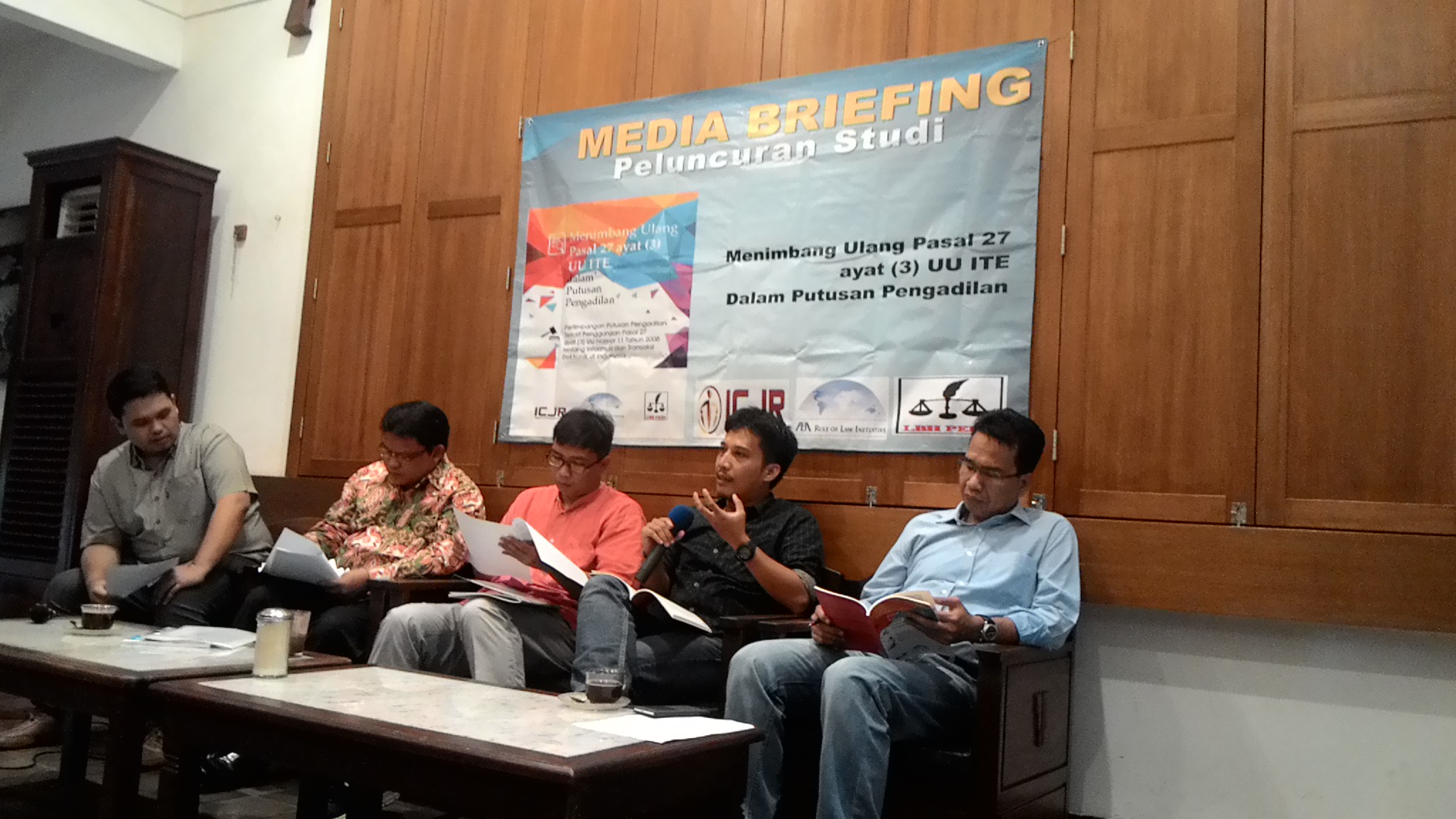
ICJR's Media Briefing. Photo by: NNP
Nearly a decade has passed since the effective enforcement of Law No. 11 of 2008 on Electronic Information and Transactions (ITE Law). During this period, some 20 court rulings relating to defamation cases involving internet users (commonly known as “netizens”) have referenced Article 27 (3) of the ITE Law and have secured legally binding (inkracht) status.
“Out of some 20 cases [which have been decided], at least some rulings have been made which may ultimately serve as references during the deliberation of other [similar] cases,” Mr. Eddyono explained during a discussion held in Jakarta on Saturday, 13 February 2016.
According to ICJR data, at least three fundamental legal arguments have been made by the various panels of judges who have presided over these cases, either at the first-instance level or at the Supreme Court (MA) level. Such legal reasoning can be considered a proper implementation of the norms of criminal procedural law, which also respects the freedom-of-expression principle.
The first element of such legal reasoning emphasizes that Article 27 (3) of the ITE Law covers absolute-complaint offenses. This means that any offense caused based on Article 27 (3) can only be reported or filed by the so-called “direct victims” of the offense in question. However, the majority of cases mirror the one filed at the Bantul District Court, in which the reporting party was not actually the so-called “direct victim” of the claimed offense in question.
During the legal reasoning which ended up being incorporated under Bantul District Court Ruling No. 196/Pid.Sus/2014/PN.BTL, the panel of judges referred to Constitutional Court (MK) Ruling No. 50/PUU-VI/2008, and emphasized the fact that the interpretation of Article 27 (3) of the ITE Law was inseparable from its “lex generali” provisions, namely Articles 310 and 311 of the Indonesian Criminal Code (KUHP) (meaning that the case in question constitutes an absolute-complaint offense).
“It is important to note that in several cases, Article 27 (3) of the ITE Law has been interpreted as meaning conventional offense [which can be reported or filed by any party],” asserted Mr. Eddyono.
Another similar ruling can be found in Raba Bima District Court Ruling No. 292/Pid.B/2014/PN.Rbi. Khairudin M. Ali, the Bima City General Election Oversight Committee’s (Panwaslu) Coordinator of Oversight and Inter-Institution Relations, was reported to the police for mentioning a suspected violation which took place during the 2014 general election through his Facebook account. The panel of judges declared Mr. Ali to be not guilty of any criminal offense based on the legal reasoning that a statement without a direct mention of a name lacks the crucial element of defamation.
“The Raba Bima District Court emphasized the importance of the direct mention of a name which should accompany any accusation,” asserted Mr. Eddyono.
The second important element of such legal disputes involves the validation of digital evidence. According to Article 5 (1) and (2) of the ITE Law, digital evidence may either serve as documentary evidence, or as hints/clues [as prescribed under Indonesian Criminal Procedural Law (KUHAP)], or also serve as a whole new type of evidence. Moreover, Article 6 of the ITE Law stipulates that digital evidence can be considered a legitimate form of evidence, provided that such evidence is both accessible and displayable, is of valid integrity [or possesses wholeness, i.e. is not damaged or has not been tampered with or modified], and can be accounted for in its entirety.
The ICJR noted two cases in which the panels of judges involved displayed a proper thoroughness when examining digital evidence and its validation. The first case produced South Jakarta District Court Ruling No. 1832/Pid.B/2012/PN.Jkt.Sel. This court ruling found M. Fajrika Firza, believed to be the owner of the @fajriska Twitter account, to be not guilty. The panel of judges concluded that a Twitter account under a specific name could be created by anybody, and not necessarily the person reflected in the account’s username.
The second case resulted in Makasar District Court Ruling No. 390/Pid.B/2014/PN.Mks. This ruling found the accused M. Arsyad to be not guilty of defaming A. Kadir Halid, Makasar’s mayoral candidate for the 2013 period, via the Blackberry Messenger (BBM) personal-message service. In order to determine whether the BBM evidence printed out and involving PIN No. 215000AA was actually from Mr. Arsyad’s BBM account, the panel of judges ended up using two validation methods. The first method involved summoning two or more persons listed in Mr. Arsyad’s BBM contacts to testify whether the above BBM PIN number was indeed owned by Mr. Arsyad. The second method involved a digital forensic investigation which aimed to determine whether the owner of the BBM PIN number in question actually wrote the alleged defamatory message.
“In several proper court rulings, this [the ICJR’s] research found that the judges involved validated the digital evidence that they were presented with quite thoroughly,” asserted Mr. Eddyono.
The third legal element of such disputes relates to the notion of legal justification (alasan pembenar), as stipulated under Article 27 (3) of the ITE Law through the use of the term “intentional and unlawful [tanpa hak]”. According to ICJR data, Tangerang District Court Ruling No. 1269/PID.B/2009 PN.TNG represents proof that panels of judges consider the “unlawful” element to be sufficient legal justification when sentencing or releasing someone from a criminal offense.
The criminal accusation that befell Prita Mulyasari, accused of defaming a hospital and its staff, shows that actions ostensibly undertaken in the public interest, or when a party is under pressure to defend themselves, can allow said party to lawfully distribute, transmit, and make accessible electronic information, even though the nature of its contents may be defamatory. In this case, the panel of judges declared that Ms. Mulyasari’s email did not constitute an act of defamation.
“One of the greatest advances seen in several courts across the country is the acknowledgement of the penal-nullification principle if a potentially defamatory statement is made in the public interest, is accurate, and relates to the duties and responsibilities prescribed under prevailing laws and regulations,” concluded Mr. Eddyono.
Civil Disputes
Also present at the discussion event was Ifdhal Kasim, former Chair of the National Commission for Human Rights (Komnas HAM), who asserted that digital defamation should have been prescribed as a type of civil dispute, allowing parties who feel that their name has been the subject of defamatory acts to file civil lawsuits. Mr. Kasim expressed his belief that this would help to avoid abuses of authority by law enforcement officers.
“They [acts of alleged defamation] can be processed through civil lawsuits. The government should therefore not involve itself in such proceedings, which can instead be settled directly by the parties involved,” asserted Mr. Kasim.
Mr. Kasim bases this recommendation on the United Nation Human Rights Councils’ (UNHRC) assessment that accusations of defamation in a number of countries are often abused by the governing authorities. Moreover, from the perspective of human rights, incriminating defamation does not necessarily constitute a violation of a party’s reputation and dignity.
“The protection [of a person’s dignity and reputation] is not absolute, its nature is derogable and can be limited,” concluded Mr. Kasim.
(rfs/sp)
Marcell Sihombing, Nando Narendra
ICJR's Media Briefing. Photo by: NNP
Nearly a decade has passed since the effective enforcement of Law No. 11 of 2008 on Electronic Information and Transactions (ITE Law). During this period, some 20 court rulings relating to defamation cases involving internet users (commonly known as “netizens”) have referenced Article 27 (3) of the ITE Law and have secured legally binding (inkracht) status.
“Out of some 20 cases [which have been decided], at least some rulings have been made which may ultimately serve as references during the deliberation of other [similar] cases,” Mr. Eddyono explained during a discussion held in Jakarta on Saturday, 13 February 2016.
According to ICJR data, at least three fundamental legal arguments have been made by the various panels of judges who have presided over these cases, either at the first-instance level or at the Supreme Court (MA) level. Such legal reasoning can be considered a proper implementation of the norms of criminal procedural law, which also respects the freedom-of-expression principle.
The first element of such legal reasoning emphasizes that Article 27 (3) of the ITE Law covers absolute-complaint offenses. This means that any offense caused based on Article 27 (3) can only be reported or filed by the so-called “direct victims” of the offense in question. However, the majority of cases mirror the one filed at the Bantul District Court, in which the reporting party was not actually the so-called “direct victim” of the claimed offense in question.
During the legal reasoning which ended up being incorporated under Bantul District Court Ruling No. 196/Pid.Sus/2014/PN.BTL, the panel of judges referred to Constitutional Court (MK) Ruling No. 50/PUU-VI/2008, and emphasized the fact that the interpretation of Article 27 (3) of the ITE Law was inseparable from its “lex generali” provisions, namely Articles 310 and 311 of the Indonesian Criminal Code (KUHP) (meaning that the case in question constitutes an absolute-complaint offense).
“It is important to note that in several cases, Article 27 (3) of the ITE Law has been interpreted as meaning conventional offense [which can be reported or filed by any party],” asserted Mr. Eddyono.
Another similar ruling can be found in Raba Bima District Court Ruling No. 292/Pid.B/2014/PN.Rbi. Khairudin M. Ali, the Bima City General Election Oversight Committee’s (Panwaslu) Coordinator of Oversight and Inter-Institution Relations, was reported to the police for mentioning a suspected violation which took place during the 2014 general election through his Facebook account. The panel of judges declared Mr. Ali to be not guilty of any criminal offense based on the legal reasoning that a statement without a direct mention of a name lacks the crucial element of defamation.
“The Raba Bima District Court emphasized the importance of the direct mention of a name which should accompany any accusation,” asserted Mr. Eddyono.
The second important element of such legal disputes involves the validation of digital evidence. According to Article 5 (1) and (2) of the ITE Law, digital evidence may either serve as documentary evidence, or as hints/clues [as prescribed under Indonesian Criminal Procedural Law (KUHAP)], or also serve as a whole new type of evidence. Moreover, Article 6 of the ITE Law stipulates that digital evidence can be considered a legitimate form of evidence, provided that such evidence is both accessible and displayable, is of valid integrity [or possesses wholeness, i.e. is not damaged or has not been tampered with or modified], and can be accounted for in its entirety.
The ICJR noted two cases in which the panels of judges involved displayed a proper thoroughness when examining digital evidence and its validation. The first case produced South Jakarta District Court Ruling No. 1832/Pid.B/2012/PN.Jkt.Sel. This court ruling found M. Fajrika Firza, believed to be the owner of the @fajriska Twitter account, to be not guilty. The panel of judges concluded that a Twitter account under a specific name could be created by anybody, and not necessarily the person reflected in the account’s username.
The second case resulted in Makasar District Court Ruling No. 390/Pid.B/2014/PN.Mks. This ruling found the accused M. Arsyad to be not guilty of defaming A. Kadir Halid, Makasar’s mayoral candidate for the 2013 period, via the Blackberry Messenger (BBM) personal-message service. In order to determine whether the BBM evidence printed out and involving PIN No. 215000AA was actually from Mr. Arsyad’s BBM account, the panel of judges ended up using two validation methods. The first method involved summoning two or more persons listed in Mr. Arsyad’s BBM contacts to testify whether the above BBM PIN number was indeed owned by Mr. Arsyad. The second method involved a digital forensic investigation which aimed to determine whether the owner of the BBM PIN number in question actually wrote the alleged defamatory message.
“In several proper court rulings, this [the ICJR’s] research found that the judges involved validated the digital evidence that they were presented with quite thoroughly,” asserted Mr. Eddyono.
The third legal element of such disputes relates to the notion of legal justification (alasan pembenar), as stipulated under Article 27 (3) of the ITE Law through the use of the term “intentional and unlawful [tanpa hak]”. According to ICJR data, Tangerang District Court Ruling No. 1269/PID.B/2009 PN.TNG represents proof that panels of judges consider the “unlawful” element to be sufficient legal justification when sentencing or releasing someone from a criminal offense.
The criminal accusation that befell Prita Mulyasari, accused of defaming a hospital and its staff, shows that actions ostensibly undertaken in the public interest, or when a party is under pressure to defend themselves, can allow said party to lawfully distribute, transmit, and make accessible electronic information, even though the nature of its contents may be defamatory. In this case, the panel of judges declared that Ms. Mulyasari’s email did not constitute an act of defamation.
“One of the greatest advances seen in several courts across the country is the acknowledgement of the penal-nullification principle if a potentially defamatory statement is made in the public interest, is accurate, and relates to the duties and responsibilities prescribed under prevailing laws and regulations,” concluded Mr. Eddyono.
Civil Disputes
Also present at the discussion event was Ifdhal Kasim, former Chair of the National Commission for Human Rights (Komnas HAM), who asserted that digital defamation should have been prescribed as a type of civil dispute, allowing parties who feel that their name has been the subject of defamatory acts to file civil lawsuits. Mr. Kasim expressed his belief that this would help to avoid abuses of authority by law enforcement officers.
“They [acts of alleged defamation] can be processed through civil lawsuits. The government should therefore not involve itself in such proceedings, which can instead be settled directly by the parties involved,” asserted Mr. Kasim.
Mr. Kasim bases this recommendation on the United Nation Human Rights Councils’ (UNHRC) assessment that accusations of defamation in a number of countries are often abused by the governing authorities. Moreover, from the perspective of human rights, incriminating defamation does not necessarily constitute a violation of a party’s reputation and dignity.
“The protection [of a person’s dignity and reputation] is not absolute, its nature is derogable and can be limited,” concluded Mr. Kasim.
(rfs/sp)