


 Ada Pertanyaan? Hubungi Kami


2026 Hak Cipta Milik Hukumonline.com
Produk Pilihan


 Ada Pertanyaan? Hubungi Kami
Marcell Sihombing, Ady TD Achmad
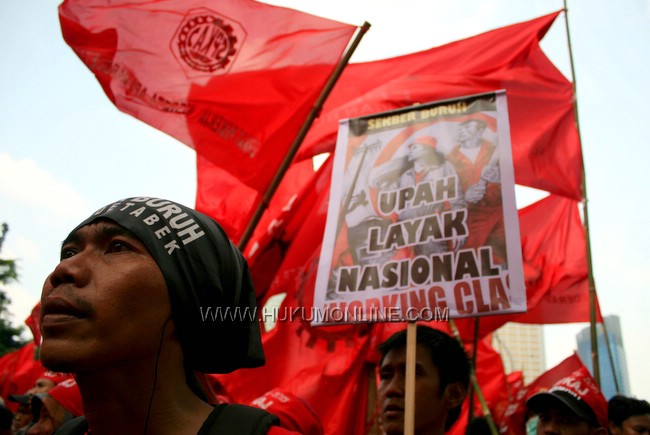
Labors during a rally. Photo: SGP
The issue of minimum wage has always been at the heart of labor demands across Indonesia, and it is against this background that the various labor unions that make up the Confederation of Indonesian Workers Union (Konfederasi Serikat Pekerja Indonesia – KSPI) have demanded a 22-percent rise in the 2016 minimum wage. The demand was made at a press conference held in Jakarta on Monday, 28 September.
Said Iqbal, President of the KSPI, asserted that this figure was arrived at after a survey of 84 cost-of-living index (KHL) items, which the KSPI carried out at a number of different markets. Mr. Iqbal further revealed that the 22-percent figure was arrived at after an analysis of only 80 percent of the KSPI survey results. This is because the government currently only recognizes 60 KHL items, and these items are stipulated under Minister of Employment and Transmigration Regulation No. 13 of 2012 (2012 Regulation).
Mr. Iqbal stated that he was aware that the government was at liberty to disagree with the KSPI’s total of 84 KHL items however, and was free to assess only 60 KHL items as mandated by the 2012 Regulation instead. There should though, according to Mr. Iqbal, be a chance for stakeholders to negotiate with the government as regards the 2016 minimum wage.
Mr. Iqbal stated that workers intend to push for the 22-percent minimum wage hike, provided that the rupiah-to-US dollar exchange rate does not suffer any severe drop. Should the exchange rate fall below a certain level though, then Indonesian labor will naturally lower its demands.
Indeed, such measures would be necessary in order to prevent massive layoffs, and Mr. Iqbal stressed that he was well aware that the current economic slowdown and slump in the rupiah exchange rate was the primary cause of redundancies in the labor force.
No widespread redundancies are on the cards in Indonesia as yet however, and Mr. Iqbal revealed that, according to KSPI data, of the 100,000 KSPI members who are currently suffering the impacts of the economic slowdown and the dropping exchange rate, most are only suffering a reduction in their working hours, as opposed to actually losing their jobs outright.
Mr. Iqbal said that the government needed to establish a policy designed to strengthen the exchange rate, something that it was well-equipped to do. However, Mr. Iqbal also stated that he strongly suspected that the government was instead focusing upon keeping any potential rise in the national minimum wage to a minimum.
This suspicion, according to Mr. Iqbal, has been further reinforced in the wake of the government establishing an annual minimum-wage rise formula and stating its intention to incorporate this formula into the Draft Regulation on Salary (Draft Regulation), which is currently being deliberated. Mr. Iqbal predicted that, should this formula pass into law, then the minimum-wage hike would be set at a measly 9 percent per year.
Mr. Iqbal expressed his firm belief that the government’s minimum-wage formula would eventually snuff out the purchasing power of workers, as such a modest rise in the minimum wage would not be able to compete with the skyrocketing prices currently being driven by inflation. Mr. Iqbal stressed that this low purchasing power would instead severely reduce domestic consumption, the most crucial element in the current bid to stimulate stagnating economic growth in the country.
“Should the government insist on utilizing its formula in calculating the minimum-wage hike, then workers will ready themselves for a nationwide strike that will take place in November,” asserted Mr. Iqbal.
In line with Mr. Iqbal, the Chair of National Workers Union (Serikat Pekerja Nasional – SPN), Iwan Kusmawan, stated that incorporating the above formula into the Draft Regulation and then implementing it would mean that the government was not being supportive of the labor force.
Furthermore, Mr. Kusmawan also warned regional governments to take the recommendations of the salary boards (dewan pengupahan) in their respective regions into consideration before determining the 2016 minimum wage. Mr. Kusmawan said that several regional governors had already hinted that they would deliberately disregard any recommendations given to them by their local salary boards as they determined the new minimum wage.
“If the government does not commit itself to increasing the wealth of workers by raising the minimum wage, then we can only label the government as tyrants,” concluded Mr. Kusmawan.
(sp)
Marcell Sihombing, Ady TD Achmad
Labors during a rally. Photo: SGP
The issue of minimum wage has always been at the heart of labor demands across Indonesia, and it is against this background that the various labor unions that make up the Confederation of Indonesian Workers Union (Konfederasi Serikat Pekerja Indonesia – KSPI) have demanded a 22-percent rise in the 2016 minimum wage. The demand was made at a press conference held in Jakarta on Monday, 28 September.
Said Iqbal, President of the KSPI, asserted that this figure was arrived at after a survey of 84 cost-of-living index (KHL) items, which the KSPI carried out at a number of different markets. Mr. Iqbal further revealed that the 22-percent figure was arrived at after an analysis of only 80 percent of the KSPI survey results. This is because the government currently only recognizes 60 KHL items, and these items are stipulated under Minister of Employment and Transmigration Regulation No. 13 of 2012 (2012 Regulation).
Mr. Iqbal stated that he was aware that the government was at liberty to disagree with the KSPI’s total of 84 KHL items however, and was free to assess only 60 KHL items as mandated by the 2012 Regulation instead. There should though, according to Mr. Iqbal, be a chance for stakeholders to negotiate with the government as regards the 2016 minimum wage.
Mr. Iqbal stated that workers intend to push for the 22-percent minimum wage hike, provided that the rupiah-to-US dollar exchange rate does not suffer any severe drop. Should the exchange rate fall below a certain level though, then Indonesian labor will naturally lower its demands.
Indeed, such measures would be necessary in order to prevent massive layoffs, and Mr. Iqbal stressed that he was well aware that the current economic slowdown and slump in the rupiah exchange rate was the primary cause of redundancies in the labor force.
No widespread redundancies are on the cards in Indonesia as yet however, and Mr. Iqbal revealed that, according to KSPI data, of the 100,000 KSPI members who are currently suffering the impacts of the economic slowdown and the dropping exchange rate, most are only suffering a reduction in their working hours, as opposed to actually losing their jobs outright.
Mr. Iqbal said that the government needed to establish a policy designed to strengthen the exchange rate, something that it was well-equipped to do. However, Mr. Iqbal also stated that he strongly suspected that the government was instead focusing upon keeping any potential rise in the national minimum wage to a minimum.
This suspicion, according to Mr. Iqbal, has been further reinforced in the wake of the government establishing an annual minimum-wage rise formula and stating its intention to incorporate this formula into the Draft Regulation on Salary (Draft Regulation), which is currently being deliberated. Mr. Iqbal predicted that, should this formula pass into law, then the minimum-wage hike would be set at a measly 9 percent per year.
Mr. Iqbal expressed his firm belief that the government’s minimum-wage formula would eventually snuff out the purchasing power of workers, as such a modest rise in the minimum wage would not be able to compete with the skyrocketing prices currently being driven by inflation. Mr. Iqbal stressed that this low purchasing power would instead severely reduce domestic consumption, the most crucial element in the current bid to stimulate stagnating economic growth in the country.
“Should the government insist on utilizing its formula in calculating the minimum-wage hike, then workers will ready themselves for a nationwide strike that will take place in November,” asserted Mr. Iqbal.
In line with Mr. Iqbal, the Chair of National Workers Union (Serikat Pekerja Nasional – SPN), Iwan Kusmawan, stated that incorporating the above formula into the Draft Regulation and then implementing it would mean that the government was not being supportive of the labor force.
Furthermore, Mr. Kusmawan also warned regional governments to take the recommendations of the salary boards (dewan pengupahan) in their respective regions into consideration before determining the 2016 minimum wage. Mr. Kusmawan said that several regional governors had already hinted that they would deliberately disregard any recommendations given to them by their local salary boards as they determined the new minimum wage.
“If the government does not commit itself to increasing the wealth of workers by raising the minimum wage, then we can only label the government as tyrants,” concluded Mr. Kusmawan.
(sp)