


 Ada Pertanyaan? Hubungi Kami


2026 Hak Cipta Milik Hukumonline.com
Produk Pilihan


 Ada Pertanyaan? Hubungi Kami
Jasmine Abdurrachim, Fitri Novia Heriani
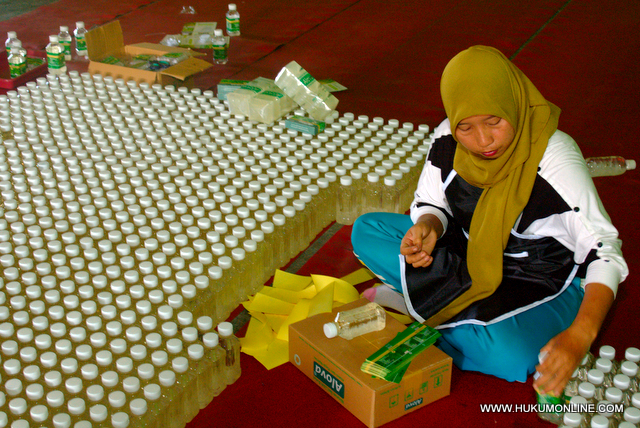
SME's worker in West Sumbawa. Photo by: ADY
Regarding its apparent failure to learn any lessons from the 1997-1998 Asian financial crisis, the Government has just received some sharp criticism from Bahlil Lahadalia, Head of the Indonesian Young Entrepreneurs Association (“HIPMI”). According to Lahadalia, SMEs (small-medium scale enterprises) proved to be more capable of survival than larger scale enterprises during the previous crisis. Then, as now, large sums of money were idle, many workers were laid off, and stimulus measures were slow in coming and ineffective.
“From the VOC era up until the present, Indonesia exports not much more than a large amount of nutmegs and cloves. For centuries nothing has changed, there is no added value,” added Mr. Lahadalia.
Mr. Lahadalia’s hope is that the Government will be able to shift the center of economic activity to rural areas by formulating a program designed to increase both the number of SMEs and regional economic empowerment. The HIPMI head believes that currently, the economy is only focused in the country’s big cities. Policy makers should be aware of the importance of encouraging and developing value-added economy. Therefore, according to Lahadalia, the government should be seeking to boost entrepreneurship and the SME sector in order to accelerate economic growth during the current downturn.
In an attempt to revive economic growth, the government has formulated and is currently implementing a number of policies, such as the retention regulation regarding primary goods and essentials, as set forth in Presidential Regulation No. 71 of 2015 on Pricing and Storage of Basic Needs and Important Goods. Despite the government’s efforts however, the sluggish economy is a result not only of domestic factors, but is also being exacerbated by the global economic slowdown.
Finance Minister, Bambang Brodjonegoro, recently admitted though that the severity of the current recession could have been avoided, had the government shown greater anticipation and acted more proactively. Indonesia’s tardiness in anticipating the downturn has affected many sectors, and the current economic situation looks bleak in the country.
The currently slowing national economy also reveals that the government has not adequately formulated a long-term strategy with regard to development. Indonesia continues to offer only short-term economic initiatives, and this has led to a weakening of the country’s fundamentals. Stakeholders were complacent when the prices of commodities were high, and this has led to an economic time bomb which could explode at any time.
"Generally speaking, there is a cycle that applies to economic conditions. Sometimes we’re on top and sometimes we are in a trough. However, we are often late in anticipating the downward cycle. We need to remember the cyclical nature of economies and should not be fooled into thinking that the upswing is more permanent than it in fact is," concluded Mr. Brodjonegoro in a discussion held in Jakarta on 9 September 2015.
(sp)
Jasmine Abdurrachim, Fitri Novia Heriani
SME's worker in West Sumbawa. Photo by: ADY
Regarding its apparent failure to learn any lessons from the 1997-1998 Asian financial crisis, the Government has just received some sharp criticism from Bahlil Lahadalia, Head of the Indonesian Young Entrepreneurs Association (“HIPMI”). According to Lahadalia, SMEs (small-medium scale enterprises) proved to be more capable of survival than larger scale enterprises during the previous crisis. Then, as now, large sums of money were idle, many workers were laid off, and stimulus measures were slow in coming and ineffective.
“From the VOC era up until the present, Indonesia exports not much more than a large amount of nutmegs and cloves. For centuries nothing has changed, there is no added value,” added Mr. Lahadalia.
Mr. Lahadalia’s hope is that the Government will be able to shift the center of economic activity to rural areas by formulating a program designed to increase both the number of SMEs and regional economic empowerment. The HIPMI head believes that currently, the economy is only focused in the country’s big cities. Policy makers should be aware of the importance of encouraging and developing value-added economy. Therefore, according to Lahadalia, the government should be seeking to boost entrepreneurship and the SME sector in order to accelerate economic growth during the current downturn.
In an attempt to revive economic growth, the government has formulated and is currently implementing a number of policies, such as the retention regulation regarding primary goods and essentials, as set forth in Presidential Regulation No. 71 of 2015 on Pricing and Storage of Basic Needs and Important Goods. Despite the government’s efforts however, the sluggish economy is a result not only of domestic factors, but is also being exacerbated by the global economic slowdown.
Finance Minister, Bambang Brodjonegoro, recently admitted though that the severity of the current recession could have been avoided, had the government shown greater anticipation and acted more proactively. Indonesia’s tardiness in anticipating the downturn has affected many sectors, and the current economic situation looks bleak in the country.
The currently slowing national economy also reveals that the government has not adequately formulated a long-term strategy with regard to development. Indonesia continues to offer only short-term economic initiatives, and this has led to a weakening of the country’s fundamentals. Stakeholders were complacent when the prices of commodities were high, and this has led to an economic time bomb which could explode at any time.
"Generally speaking, there is a cycle that applies to economic conditions. Sometimes we’re on top and sometimes we are in a trough. However, we are often late in anticipating the downward cycle. We need to remember the cyclical nature of economies and should not be fooled into thinking that the upswing is more permanent than it in fact is," concluded Mr. Brodjonegoro in a discussion held in Jakarta on 9 September 2015.
(sp)