


 Ada Pertanyaan? Hubungi Kami


2026 Hak Cipta Milik Hukumonline.com
Produk Pilihan


 Ada Pertanyaan? Hubungi Kami
Jasmine Abdurrachim
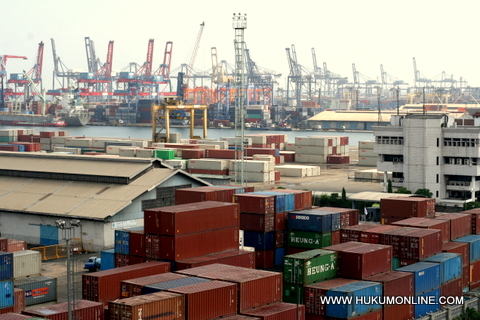 President Joko Widodo is concerned about Indonesia’s international reputation with regard to sluggish dwelling times and lengthy cargo processing up at Jakarta’s main port of Tanjung Priok. The President believes that lengthy processing times make a terrible impression on exporters and should be reduced as quickly as possible.
Solutions may not be so easy implement, as a number of licensing institutions are involved in this issue. Currently, however, various strategies are being employed in order to deal with the problem, and the combined resources of Bareskrim, Polda Metro Jaya and PPTAK have all been called upon to tackle the cargo question.
Bobby R. Mamahit, Director General of Maritime Affairs, is disinclined to add credence to allegations of port mafias hampering the smooth running of export operations around the country, however. Mamahit argues that ship operators at the country’s ports are nowadays commanded by computerized systems, and that it would be impossible for operators to act step outside the bounds of such systems.
“Ports are now fully computerized and operators can only receive and carry out commands given to them via the system. Should bribery actually occur therefore, it means that all operators at a given port would need to be bribed, as these computerized systems are fully transparent. I therefore guarantee that bribery at the country’s ports does most likely not exist,” claimed Mr. Mamahit.
One solution that Mr. Mamahit suggests is for ships’ documents to be submitted to the customs department at the Ministry of Finance prior to docking. Mr. Mamahit stated in Jakarta on Monday (24/8) that the submission of documents for customs processing prior to the docking of ships was a service currently only enjoyed by ships sailing in priority lanes, which amounts to only ten percent of the total traffic.
In contrast, 90 percent of document submissions occur after a ship has already docked. Mr. Mamahit therefore suggests that all lanes be opened up to such early processing in order to reduce dwelling times. According to Mamahit, document submissions should be undertaken four days prior to docking. Theoretically at least, this would reduce the lengthy dwelling times without the need to amend the current regulations.
Despite Mr. Mamahit’s protestations, however, the Criminal Investigation Agency (“Bareskrim”) recently managed to uncover a dwelling time scandal at Jakarta’s main port of Tanjung Priok, and a number of suspects were detained during the investigations after being accused of bribery and money laundering.
Commissioner General Budi Waseso, Head of Bareskrim Polri, affirmed on Friday (7/8) that current investigations are not only focusing their efforts on the country’s main ports, but also on smaller ports across Indonesia.
Meanwhile, with regard to the Metro Jaya Regional Police Office (“Polda Metro Jaya”) and its handling of the present dwelling-time scandal, Mr. Waseso is confident that the Regional Police are capable handling individual cases on their own and says that Bareskrim will only be taking on an assisting role during investigations.
Muhammad Yusuf, Head of the Indonesian Financial Transaction Reports and Analysis Centre (“PPATK”) has also pledged his support, especially with regard to inquiries into cases of money laundering. Mr. Yusuf has also affirmed Polda Metro Jaya’s request for assistance regarding the issue and has stated that he is optimistic that such cooperation between law enforcers and other institutions will ensure that this thorny can be brought to a speedy resolution. According to Mr. Yusuf, the outcome of this case is not just an internal matter for the country but also reflects upon Indonesia’s reputation in the eyes of the world beyond.
“We will be going all out in order to assist Polda Metro Jaya in their investigations and will be on hand to deal with any requests that they make of us,” proclaimed Mr. Yusuf.
(sp)
Jasmine Abdurrachim
President Joko Widodo is concerned about Indonesia’s international reputation with regard to sluggish dwelling times and lengthy cargo processing up at Jakarta’s main port of Tanjung Priok. The President believes that lengthy processing times make a terrible impression on exporters and should be reduced as quickly as possible.Solutions may not be so easy implement, as a number of licensing institutions are involved in this issue. Currently, however, various strategies are being employed in order to deal with the problem, and the combined resources of Bareskrim, Polda Metro Jaya and PPTAK have all been called upon to tackle the cargo question.
Bobby R. Mamahit, Director General of Maritime Affairs, is disinclined to add credence to allegations of port mafias hampering the smooth running of export operations around the country, however. Mamahit argues that ship operators at the country’s ports are nowadays commanded by computerized systems, and that it would be impossible for operators to act step outside the bounds of such systems.
“Ports are now fully computerized and operators can only receive and carry out commands given to them via the system. Should bribery actually occur therefore, it means that all operators at a given port would need to be bribed, as these computerized systems are fully transparent. I therefore guarantee that bribery at the country’s ports does most likely not exist,” claimed Mr. Mamahit.
One solution that Mr. Mamahit suggests is for ships’ documents to be submitted to the customs department at the Ministry of Finance prior to docking. Mr. Mamahit stated in Jakarta on Monday (24/8) that the submission of documents for customs processing prior to the docking of ships was a service currently only enjoyed by ships sailing in priority lanes, which amounts to only ten percent of the total traffic.
In contrast, 90 percent of document submissions occur after a ship has already docked. Mr. Mamahit therefore suggests that all lanes be opened up to such early processing in order to reduce dwelling times. According to Mamahit, document submissions should be undertaken four days prior to docking. Theoretically at least, this would reduce the lengthy dwelling times without the need to amend the current regulations.
Despite Mr. Mamahit’s protestations, however, the Criminal Investigation Agency (“Bareskrim”) recently managed to uncover a dwelling time scandal at Jakarta’s main port of Tanjung Priok, and a number of suspects were detained during the investigations after being accused of bribery and money laundering.
Commissioner General Budi Waseso, Head of Bareskrim Polri, affirmed on Friday (7/8) that current investigations are not only focusing their efforts on the country’s main ports, but also on smaller ports across Indonesia.
Meanwhile, with regard to the Metro Jaya Regional Police Office (“Polda Metro Jaya”) and its handling of the present dwelling-time scandal, Mr. Waseso is confident that the Regional Police are capable handling individual cases on their own and says that Bareskrim will only be taking on an assisting role during investigations.
Muhammad Yusuf, Head of the Indonesian Financial Transaction Reports and Analysis Centre (“PPATK”) has also pledged his support, especially with regard to inquiries into cases of money laundering. Mr. Yusuf has also affirmed Polda Metro Jaya’s request for assistance regarding the issue and has stated that he is optimistic that such cooperation between law enforcers and other institutions will ensure that this thorny can be brought to a speedy resolution. According to Mr. Yusuf, the outcome of this case is not just an internal matter for the country but also reflects upon Indonesia’s reputation in the eyes of the world beyond.
“We will be going all out in order to assist Polda Metro Jaya in their investigations and will be on hand to deal with any requests that they make of us,” proclaimed Mr. Yusuf.
(sp)