


 Ada Pertanyaan? Hubungi Kami


2026 Hak Cipta Milik Hukumonline.com
Produk Pilihan


 Ada Pertanyaan? Hubungi Kami
Marcell Sihombing, Ali Salmande Harahap
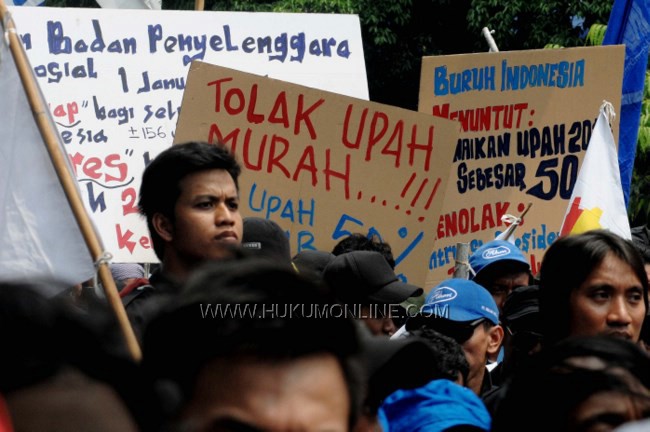 The issue of the minimum wage standards has always been and remains the single most important issue between workers and employers. A standard outcome is that when regional governments determine the minimum wage at the end of every year, employers are usually to file for a suspension of payments of the newly determined minimum wage. In response, workers use every possible means they have to prevent this from happening.
After many years of this squabbling employees have decided to try a different approach to this problem by initiating a review of Article 90 (2) of the Labor Law and its elucidation, the legal basis for employers to request a suspension of payment the minimum wage. The United Independent Labor Union (GSBM) and the Labor Awakening Union (SBB) filed the judicial review with the Constitutional Court, arguing that the clause denied workers’ rights to receive a minimum wage.
Article 90 (2) of the Labor Law allows employers to suspend the payment of minimum wage, if they are incapable, and its elucidation stipulates that the suspension waives the respective employer to pay the minimum wage for certain period of time. The elucidation also stipulated that incapable employers must pay up-t0-date minimum wage when the period is over, and is unclear as to whether any payment deficiencies will have to be covered at a later time.
“Article 90 (2) clearly puts workers at a disadvantage,” said Pelikson Silitonga, the applicants’ attorney at the preliminary hearing at the Constitutional Court last Wednesday.
Mr. Silitonga pointed out that Article 90 (2) contradicts Article 90 (1), which prohibits companies to pay a salary lower than the prescribed minimum wage. He also argues that the elucidation of Article 90 (2) fails to further elaborate the meaning of “incapable”, and consequently it contradicts legal certainty and fairness as required under Articles 28D (1) and (2) of the 1945 Constitution.
According to Mr. Silitonga, Article 90 (2) fails to satisfy the fairness principle, as it does not oblige employer companies to pay the deviation from the minimum wage during the suspension. He argues that the definition of ‘suspension’ means that when a company can afford to pay the residual shortage, they are obliged to pay it either on in same year or by rolling it over into next year’s payment.
“Mandatory minimum wages are without exceptions solely intended to ensure a worker’s right to a decent live,” Mr. Silitonga concluded.
Responding to the petition, Justice Manahan MP Sitompul—chairman of the panel—requested the applicants to make the petition clearer and easy-to-understand. He suggested the applicants clearly define the duration of the suspension and the party authorized to grant it.
Justice Sitompul also recommended that it is better for the applicant to ask for “conditionally constitutional” regarding the reviewed articles, instead of asking for “null and void” decision. Justice Sitompul asserted his opinion that the applicant should also consider an employer’s point of view and offer some leeway by suggesting alternatives.
(hot/kc)
Marcell Sihombing, Ali Salmande Harahap
The issue of the minimum wage standards has always been and remains the single most important issue between workers and employers. A standard outcome is that when regional governments determine the minimum wage at the end of every year, employers are usually to file for a suspension of payments of the newly determined minimum wage. In response, workers use every possible means they have to prevent this from happening.After many years of this squabbling employees have decided to try a different approach to this problem by initiating a review of Article 90 (2) of the Labor Law and its elucidation, the legal basis for employers to request a suspension of payment the minimum wage. The United Independent Labor Union (GSBM) and the Labor Awakening Union (SBB) filed the judicial review with the Constitutional Court, arguing that the clause denied workers’ rights to receive a minimum wage.
Article 90 (2) of the Labor Law allows employers to suspend the payment of minimum wage, if they are incapable, and its elucidation stipulates that the suspension waives the respective employer to pay the minimum wage for certain period of time. The elucidation also stipulated that incapable employers must pay up-t0-date minimum wage when the period is over, and is unclear as to whether any payment deficiencies will have to be covered at a later time.
“Article 90 (2) clearly puts workers at a disadvantage,” said Pelikson Silitonga, the applicants’ attorney at the preliminary hearing at the Constitutional Court last Wednesday.
Mr. Silitonga pointed out that Article 90 (2) contradicts Article 90 (1), which prohibits companies to pay a salary lower than the prescribed minimum wage. He also argues that the elucidation of Article 90 (2) fails to further elaborate the meaning of “incapable”, and consequently it contradicts legal certainty and fairness as required under Articles 28D (1) and (2) of the 1945 Constitution.
According to Mr. Silitonga, Article 90 (2) fails to satisfy the fairness principle, as it does not oblige employer companies to pay the deviation from the minimum wage during the suspension. He argues that the definition of ‘suspension’ means that when a company can afford to pay the residual shortage, they are obliged to pay it either on in same year or by rolling it over into next year’s payment.
“Mandatory minimum wages are without exceptions solely intended to ensure a worker’s right to a decent live,” Mr. Silitonga concluded.
Responding to the petition, Justice Manahan MP Sitompul—chairman of the panel—requested the applicants to make the petition clearer and easy-to-understand. He suggested the applicants clearly define the duration of the suspension and the party authorized to grant it.
Justice Sitompul also recommended that it is better for the applicant to ask for “conditionally constitutional” regarding the reviewed articles, instead of asking for “null and void” decision. Justice Sitompul asserted his opinion that the applicant should also consider an employer’s point of view and offer some leeway by suggesting alternatives.
(hot/kc)