


 Ada Pertanyaan? Hubungi Kami


 Ada Pertanyaan? Hubungi Kami
Ady TD Achmad, Andin Aditya Rahman
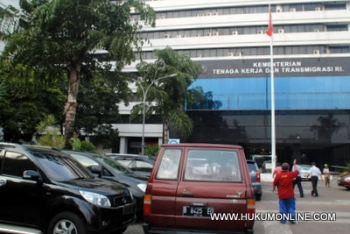 Officials from the Ministry of Labor and Transmigration (Kemenakertrans) were not available meet with the labor union groups that marched into the Ministry building to demand an investigation on outsourcing implementation in the cigarette industry.
Their demands were based on a study by Participation Indonesia, a labor union, which presented evidence that a major cigarette company paid other companies to roll their cigarettes, which is not permitted by current labor laws.
In order to protect workers, a recently-modified regulatory framework insists that “primary work” – in this case, the rolling of cigarettes by tobacco companies – must be given to laborers within that same company.
Agus Prianto, Advocacy Coordinator for Participation Indonesia, explained to Hukumonline at the Kemenakertrans building (8/1) that they were taking a stand on outsourcing, which allows companies to pass off their primary work to other companies in other domestic locales and even other countries.
The regulation sets limits on the types of work that may be outsourced to others: cleaning services, catering, security, labor transport, and support services in mining and oil industries.
The recently-specified limits are derived more broadly from Article 66 of Law No. 13 of 2003 on Labor, which states that primary work may not be sourced to other companies. However, the definition of “primary work” was until now up to interpretation.
Cigarette companies often source the rolling of cigarettes to other affiliates, the labor advocate explained; outsourcing allows them to improve production efficiency without having to make additional fixed capital investments in such things as factories, land, storage, offices, and other related necessities.
Kemenakertrans must crack down on illegal outsourcing by field verification, he said, and they must be assertive, taking decisive action when needed.
Firmness Test
Timboel Siregar, the Secretariat General of the Indonesian Workers Organization, told Hukumonline (8/1) that the study by Participation Indonesia also looked at possible violations by companies that receive outsourcing contracts.
He asserted that this is a test for the government to enforce employment laws and regulations.
“This is where the government’s role as a firm regulator is tested,” he said.
Kemenakertrans Responds
Contacted separately by Hukumonline (8/1), Ruslan Irianto Simbolon, the Ministry’s Director General of Industrial Relations, Development and Social Security, stated that he has not received a report from any of the prominent groups present at the demonstration: the Indonesian Labor Union Confederation, Indonesian Workers Organization, and Participation Indonesia.
Ruslan promised to check and assess the report, and also to request further details if necessary.
“We will act and move fast,” he concluded.
(eli)
Ady TD Achmad, Andin Aditya Rahman
Officials from the Ministry of Labor and Transmigration (Kemenakertrans) were not available meet with the labor union groups that marched into the Ministry building to demand an investigation on outsourcing implementation in the cigarette industry.
Their demands were based on a study by Participation Indonesia, a labor union, which presented evidence that a major cigarette company paid other companies to roll their cigarettes, which is not permitted by current labor laws.
In order to protect workers, a recently-modified regulatory framework insists that “primary work” – in this case, the rolling of cigarettes by tobacco companies – must be given to laborers within that same company.
Agus Prianto, Advocacy Coordinator for Participation Indonesia, explained to Hukumonline at the Kemenakertrans building (8/1) that they were taking a stand on outsourcing, which allows companies to pass off their primary work to other companies in other domestic locales and even other countries.
The regulation sets limits on the types of work that may be outsourced to others: cleaning services, catering, security, labor transport, and support services in mining and oil industries.
The recently-specified limits are derived more broadly from Article 66 of Law No. 13 of 2003 on Labor, which states that primary work may not be sourced to other companies. However, the definition of “primary work” was until now up to interpretation.
Cigarette companies often source the rolling of cigarettes to other affiliates, the labor advocate explained; outsourcing allows them to improve production efficiency without having to make additional fixed capital investments in such things as factories, land, storage, offices, and other related necessities.
Kemenakertrans must crack down on illegal outsourcing by field verification, he said, and they must be assertive, taking decisive action when needed.
Firmness Test
Timboel Siregar, the Secretariat General of the Indonesian Workers Organization, told Hukumonline (8/1) that the study by Participation Indonesia also looked at possible violations by companies that receive outsourcing contracts.
He asserted that this is a test for the government to enforce employment laws and regulations.
“This is where the government’s role as a firm regulator is tested,” he said.
Kemenakertrans Responds
Contacted separately by Hukumonline (8/1), Ruslan Irianto Simbolon, the Ministry’s Director General of Industrial Relations, Development and Social Security, stated that he has not received a report from any of the prominent groups present at the demonstration: the Indonesian Labor Union Confederation, Indonesian Workers Organization, and Participation Indonesia.
Ruslan promised to check and assess the report, and also to request further details if necessary.
“We will act and move fast,” he concluded.
(eli)