


 Ada Pertanyaan? Hubungi Kami


 Ada Pertanyaan? Hubungi Kami
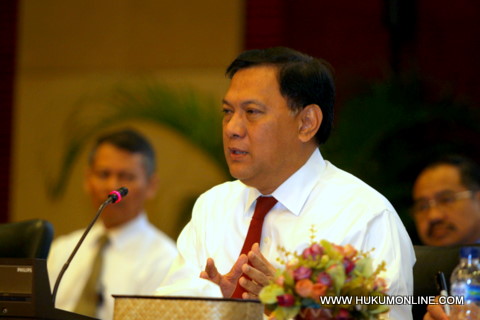 MS Hidayat, the Ministry of Industry, voiced his opinion about the issuance of Minister of Finance Regulation (PMK) No. 255/PMK.04/2001 on the Amendment of PMK No. 147/PMK.04/2011 on Bonded Areas. In a hearing with the Ministry of Finance and Commission IV of the House of Representatives (the House), Hidayat argued that the regulation burdens businesses.
Local industry, according to Hidayat, will be burdened by PMK 255. He also said the issue is related to the ongoing economic crisis in Europe and the United States. Another factor is that the production output of bonded areas to customs areas and the domestic market is limited to 25 percent.
“Industries should revise their market. The twenty-five percent, which was originally intended for the domestic market, should be exported, while the global crisis continues,” he said.
Hidayat explained that the crisis in the United States and Europe may potentially dampen the Indonesian export market. The problem is, companies have to find new markets, in order to increase exports by 50 to 75 percent. This is not simple, and it is time-consuming.
He asserted that the current conditions will cause imports to increase. What could happen, said Hidayat, is illicit trade between ASEAN members, in order to avoid the regulation. Transportation businesses will profit significantly; on the other hand, the price of products will rise and domestic products will not be able to compete with similar imported products that are relatively cheaper.
Aside from harming domestic industries, Hidayat argued that PMK 255 will cause government revenue to decrease. He explained that domestic sales generate government revenue in the form of import duties, value-added taxes on raw materials, and import income-taxes.
PMK 255 “will potentially reduce government revenue by 30-50 percent,” he said. Hidayat recommended postponing the policy, until the global economy recovers.
Airlangga Hartanto, Chairman of Commission VI, supported Hidayat’s explanation. He requested a revision of PMK 255. The revision should start with increasing the amount of production bonded areas can contribute to the domestic market.
He said that bonded area production output to the domestic market should be increased to 50 percent, to increase the competitiveness of national industries.
Minister of Finance Agus Martowardojo promised to disscuss the requests with businesses. “We will take note of the requests,” he said.
(M Agus Yozami / Mahinda Arkyasa)
MS Hidayat, the Ministry of Industry, voiced his opinion about the issuance of Minister of Finance Regulation (PMK) No. 255/PMK.04/2001 on the Amendment of PMK No. 147/PMK.04/2011 on Bonded Areas. In a hearing with the Ministry of Finance and Commission IV of the House of Representatives (the House), Hidayat argued that the regulation burdens businesses.
Local industry, according to Hidayat, will be burdened by PMK 255. He also said the issue is related to the ongoing economic crisis in Europe and the United States. Another factor is that the production output of bonded areas to customs areas and the domestic market is limited to 25 percent.
“Industries should revise their market. The twenty-five percent, which was originally intended for the domestic market, should be exported, while the global crisis continues,” he said.
Hidayat explained that the crisis in the United States and Europe may potentially dampen the Indonesian export market. The problem is, companies have to find new markets, in order to increase exports by 50 to 75 percent. This is not simple, and it is time-consuming.
He asserted that the current conditions will cause imports to increase. What could happen, said Hidayat, is illicit trade between ASEAN members, in order to avoid the regulation. Transportation businesses will profit significantly; on the other hand, the price of products will rise and domestic products will not be able to compete with similar imported products that are relatively cheaper.
Aside from harming domestic industries, Hidayat argued that PMK 255 will cause government revenue to decrease. He explained that domestic sales generate government revenue in the form of import duties, value-added taxes on raw materials, and import income-taxes.
PMK 255 “will potentially reduce government revenue by 30-50 percent,” he said. Hidayat recommended postponing the policy, until the global economy recovers.
Airlangga Hartanto, Chairman of Commission VI, supported Hidayat’s explanation. He requested a revision of PMK 255. The revision should start with increasing the amount of production bonded areas can contribute to the domestic market.
He said that bonded area production output to the domestic market should be increased to 50 percent, to increase the competitiveness of national industries.
Minister of Finance Agus Martowardojo promised to disscuss the requests with businesses. “We will take note of the requests,” he said.
(M Agus Yozami / Mahinda Arkyasa)