


 Ada Pertanyaan? Hubungi Kami


 Ada Pertanyaan? Hubungi Kami
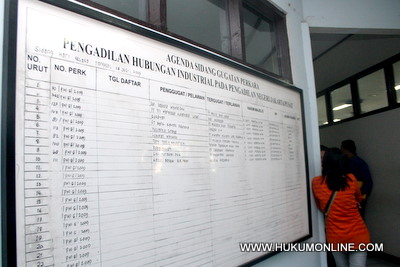
After facing a deadlock during negotiations over renewing a collective labor agreement, PT Freeport Indonesia (Freeport) filed a lawsuit against its workers, on 10 October 2011, in the Industrial Relations Court, in Jakarta. The case entered the reply (replik) phase on Monday (5/12).
In response to the trade union’s rebuttal (eksepsi), Freeport denied that the lawsuit is misguided. The company explained that the Industrial Relations Court in Jakarta has the authority to adjudicate the matter.
Freeport argued that the case falls under Article 57 of Law No. 2 of 2004 on Industrial Relations Dispute Settlements (“Law 2/2004”), which states that “the industrial relations will apply the procedures applicable in the district court, unless specifically regulated under this law”.
Furthermore, Freeport also referred to Article 81 of Law 2/2004 in conjunction with Article 24 (4) of Minister of Labor and Transmigration Decree No. KEP 48/MEN/IV/2004 (“Kepmenakertrans”) on Procedures for Preparing and Validating a Company’s Regulation and Registering Collective Labor Agreements.
Article 81 of Law 2/2004 states that an “industrial relations lawsuit must be submitted in the industrial relations court of the district court that has jurisdiction over the laborer’s workplace”. Article 24 (4) of Kepmenakertrans states that “[i]n case the settlement that is referred to in paragraph (3) does not reach a consensus, then either party may submit a claim to the industrial relations court in the jurisdiction where the laborers are working”.
In addition, Freeport refers to Article 24 (5) of Kepmenakertrans, which states ”[i]f the area where the laborers are working, as referred to in paragraph (4), falls under the jurisdiction of more than 1 (one) industrial relations court, the lawsuit must be filed in the court that has jurisdiction where the company is domiciled'.
Freeport argues that the company’s legal domicile is Jakarta, although Freeport operates in Mimika District, Papua Province and is headquartered in Jakarta.
Not Premature
Freeport also denied workers’ rebuttals (eksepsi), which claimed that the lawsuit was premature, because bi-party negotiations have not been completed. According to Freeport, bi-party negotiations, which are required to resolve an industrial relations dispute, have been conducted.
Freeport stated that the Ministry of Labor and Transmigration (“Kemenakertran”) has already issued a recommendation, so the remedies can be determined by the Industrial Relations Court in Jakarta. However, Freeport did not deny that there are ongoing negotiations in order to reach a consensus.
"The bi-party phase for industrial relations dispute settlements is complete. In order to show our good faith, the company invites the workers to negotiate, while the trial is ongoing. This is legally justified and even encouraged," said Anthony Hilman, Freeport’s legal counsel, to hukumonline in the Industrial Relations Court in Jakarta, Monday (5/12).
Supraja, the leading judge, offered to continue the trial on Thursday (8/12). However, the workers objected; and Gin do L Tobing, the workers’ attorney, said that the workers will submit a rejoinder (duplik)next week.
As previously reported, PT Freeport Indonesia (Freeport) filed a lawsuit against their workers, after facing a deadlock negotiation on renewing their collective labor agreement. The lawsuit was registered under No. 223/PHI/G/2011/PN.JKT.PST.
Freeport asked the panel of judges to accept the mediator’s recommendations, which were rejected by the trade union. The recommendations include a 25 percent salary increase over the next two years along with a health and education allowance.
The trade union questioned the Jakarta Industrial Relations Court’s jurisdiction over this case. They also stated that the lawsuit is premature. Gindo L Tobing argued that the lawsuit should be filed in the Jayapura Industrial Relations Court.
Gindo referred to Article 118 (1) of HIR (Herziene Indonesisch Reglement or Indonesian Civil Procedural Code), which states that a civil suit should be registered in the district court where the defendant is domiciled or the defendant's actual dwelling place. Wednesday (1/12).
(Ady Thea Dian Achmad / Aurora Meliala)