


 Ada Pertanyaan? Hubungi Kami


 Ada Pertanyaan? Hubungi Kami
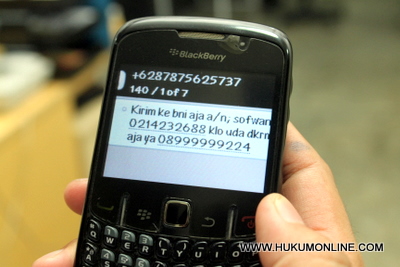 The Work Committee on Phone Credit Fraud at Commission I of the House of Representatives invited the Indonesia Consumer Protection Foundation (YLKI), Indonesian Mobile and Online Content Provider Association (IMOCA), and Feri Kuntoro, a phone credit fraud victim to a meeting on Thursday (1/12).
The Work Committee and YLKI agreed that the Indonesian Telecommunication Regulatory Agency (BRTI) is responsible for the recent phone credit fraud cases.
Sudaryatmo, the Chairman of YLKI, said that phone credit fraud conducted by content providers can be tracked back to 2009. In 2009, YLKI received many complaints from the public about this issue.
"We believe that the Ministry of Communication and Information Technology, particularly BRTI, did not do their best to oversee and warn content providers," Sudaryatmo asserted.
According to Sudaryatmo, there are many types of phone credit fraud. For example, consumers may be sent a promotion on a ring back tone that is valid for seven days. Usually, three days before the promotion expires, a notification message is sent to customers that states that the ring back tone service has been extended for 30 days, leading consumers to believe the promotion has been extended. Sudaryatmo said providers are taking advantage of consumers’ confusion.
"Providers assume that consumers agree to the service if they do not send a reply," said Sudaryatmo.
Sudaryatmo also explained that Indonesia has more operators than China, even though China's population is much larger. This could lead to unfair business practices. Therefore, Sudaryatmo hoped that the House not only oversees phone credit fraud cases, but also will re-regulate the telecommunication sector.
Ahmed Zaki Iskandar Zulkarnain, a member of the Work Committee, agreed with Sudaryatmo. Zaki said that phone credit fraud cases show how poorly BRTI's has performed.
According to Zaki, BRTI-like institutions in Malaysia and Singapore have proven their efforts to protect telecommunication consumers. BRTI, said Zaki, has to learn from them.
Meanwhile, Feri Kuntoro explained his situation to the Work Committee, where PT Colibri Network had reported him to the police.
"I don't understand the legal process. But I'm confused about why I was reported to the police," he explained.
Suspension
Tifatul Sembiring, the Minister of Communication and Information Technology, issued a policy to deactivate premium short message services in October. This policy was issued in response to the vast number of phone credit fraud cases.
In addition, BRTI also urged cellular operators to stop broadcast short messages, pop-screens, and voice broadcasts until further notification from BRTI.
However, the process for resolving this issue is taking too long, and many content providers are unhappy. "Some content providers that were not involved in phone credit fraud are also affected by this policy," said Ferrij Lumoring, Executive Director of IMOCA.
Ferrij said that if the policy is valid until February 2012, the industry will be forced to shut down. For example, M-Stars' revenue from subscriber-based content service has dropped 80 percent.
Joseph Lumban Gaol, CEO of PT Antar Mitra Prakarsa, owner of M-Stars, said that his company's revenue reached IDR 1 billion before the policy was issued. However, after the policy, it dropped to IDR 200 million.
"Content providers that relied on subscriber-based content services, will be shut down due to the policy," said Joseph.
Tantowi Yahya, Chairman of the Work Committee, said that he worried about the impact of the policy, even though he understood why it was issued. He promised that there will be a legal process to overcome this issue.
(M Agus Yozami / Pirhot Nababan)
The Work Committee on Phone Credit Fraud at Commission I of the House of Representatives invited the Indonesia Consumer Protection Foundation (YLKI), Indonesian Mobile and Online Content Provider Association (IMOCA), and Feri Kuntoro, a phone credit fraud victim to a meeting on Thursday (1/12).
The Work Committee and YLKI agreed that the Indonesian Telecommunication Regulatory Agency (BRTI) is responsible for the recent phone credit fraud cases.
Sudaryatmo, the Chairman of YLKI, said that phone credit fraud conducted by content providers can be tracked back to 2009. In 2009, YLKI received many complaints from the public about this issue.
"We believe that the Ministry of Communication and Information Technology, particularly BRTI, did not do their best to oversee and warn content providers," Sudaryatmo asserted.
According to Sudaryatmo, there are many types of phone credit fraud. For example, consumers may be sent a promotion on a ring back tone that is valid for seven days. Usually, three days before the promotion expires, a notification message is sent to customers that states that the ring back tone service has been extended for 30 days, leading consumers to believe the promotion has been extended. Sudaryatmo said providers are taking advantage of consumers’ confusion.
"Providers assume that consumers agree to the service if they do not send a reply," said Sudaryatmo.
Sudaryatmo also explained that Indonesia has more operators than China, even though China's population is much larger. This could lead to unfair business practices. Therefore, Sudaryatmo hoped that the House not only oversees phone credit fraud cases, but also will re-regulate the telecommunication sector.
Ahmed Zaki Iskandar Zulkarnain, a member of the Work Committee, agreed with Sudaryatmo. Zaki said that phone credit fraud cases show how poorly BRTI's has performed.
According to Zaki, BRTI-like institutions in Malaysia and Singapore have proven their efforts to protect telecommunication consumers. BRTI, said Zaki, has to learn from them.
Meanwhile, Feri Kuntoro explained his situation to the Work Committee, where PT Colibri Network had reported him to the police.
"I don't understand the legal process. But I'm confused about why I was reported to the police," he explained.
Suspension
Tifatul Sembiring, the Minister of Communication and Information Technology, issued a policy to deactivate premium short message services in October. This policy was issued in response to the vast number of phone credit fraud cases.
In addition, BRTI also urged cellular operators to stop broadcast short messages, pop-screens, and voice broadcasts until further notification from BRTI.
However, the process for resolving this issue is taking too long, and many content providers are unhappy. "Some content providers that were not involved in phone credit fraud are also affected by this policy," said Ferrij Lumoring, Executive Director of IMOCA.
Ferrij said that if the policy is valid until February 2012, the industry will be forced to shut down. For example, M-Stars' revenue from subscriber-based content service has dropped 80 percent.
Joseph Lumban Gaol, CEO of PT Antar Mitra Prakarsa, owner of M-Stars, said that his company's revenue reached IDR 1 billion before the policy was issued. However, after the policy, it dropped to IDR 200 million.
"Content providers that relied on subscriber-based content services, will be shut down due to the policy," said Joseph.
Tantowi Yahya, Chairman of the Work Committee, said that he worried about the impact of the policy, even though he understood why it was issued. He promised that there will be a legal process to overcome this issue.
(M Agus Yozami / Pirhot Nababan)