


 Ada Pertanyaan? Hubungi Kami


 Ada Pertanyaan? Hubungi Kami
 Although Article 28I (1) of the Constitution (UUD 1945) recognizes and guarantees the rights of the people to travel, that freedom is not an absolute freedom. The freedom to travelcan be restrictedfor national interests, basedon clear legal reasons.
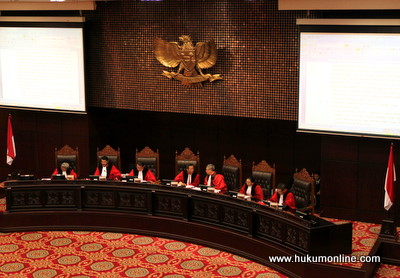
ProfessorEddy OS Hiariej gavehis opinion as anexpert witness in a trial reviewing Article 16 (1) (b) of Law No. 6 of 2011 on Immigration, at the Constitutional Court in Jakarta, Tuesday (27/9).
Seven Lawyers filed a petition to review Article 16 (1) (b) of the Immigration Law, which regulateswheninvestigators (penyelidik and penyidik) canask an immigration official to implement a travel ban (cekal). The seven petitioners are:Rico Pandeirot, Afrian Bondjol, Rachmawati, Yulius Irawansyah, Slamet Yuwono, Dewi Ekuwi Vina, andGusti Made Kartika.
The petitioners arguedthat the Article has thepotential to harm theirconstitutional rights, if,in the future,a travel ban is issued for them during an investigation, before there are certainty on the criminal acts. Prohibiting someone from travellingabroad while aninquiry (penyelidikan) process is still being conducted is considered to be an act which violates human rights.
For example, in the M Nasaruddin case, atravel ban was grantedbased onaKPK request when Nasaruddin wasstill at large. At the time,Nasaruddin’scase was still uncertain and Nasaruddin was not officially a suspect. Therefore,the petitioners asked the Constitutional Court to revoke the word “Inquiry” as stated in the article 16 (1) (b), because it conflictswith Article 28A and Article 28D (1) of the Constitution (UUD 1945).
According to Eddy, as long as a restriction on the freedom to travel (a human right) is implemented according to the law and the process is strictly regulated by the Laws, it will not be unconstitutional. The freedom to travel is not an absolute human right, it can be limited in certain situations,as regulated in the Article 28J of the Constitution.
“As long as the restriction and elimination of the right to travel is conducted withdue process according to the law then it is legitimate and not in conflict with the constitution, as long as the restriction is regulated by the law,” said the expert incriminal law from the Law Faculty of Gadjah Mada University.
As a result, Article 16 (1) (b) of Immigration Law doesnot conflict with Article 28A and Article 28D (1) of the Constitution. An “expert witness asserted that Article 16 (1) (b) Immigration Law doesnot conflict with Article 28A and Article 28D (1) of the Constitution,” said the expert who was presented by the government.
Violation of Human Rights
Meanwhile, thepetitioner’s expert witness arguedthat applyingthetravel ban while still in the inquiry process as regulated by Article 16 (1) (b) of the Immigration Law, violateshuman rights. “Therefore, atravel ban during theinquiry process conflictswith Article 28A and Article 28D (1) of the Constitution,” said the retired judge.
Another petitioner, OC Kaligis, made a similar argument. Hesaid Article 16 (1) (b) not only conflictswith national laws and the Constitution, italso conflicts with international laws thathave been ratified by Indonesia, such astheInternational Covenant on Civil and Political Rights (ICCPR) Convention ratified by Law No. 12 of 2005.
A travel ban during theinquiry process is a deprevation offreedom,which is a malfeasanceunderArticle 421 of the Indonesian Criminal Code (KUHP). Since the, a person cannot receive the status of a witness and suspect untilthe investigation (penyidikan) level,the travel ban should only be implemented when a case is at theinvestigationlevel.
(Agus Sahbani/Adi Condro Bawono)
Although Article 28I (1) of the Constitution (UUD 1945) recognizes and guarantees the rights of the people to travel, that freedom is not an absolute freedom. The freedom to travelcan be restrictedfor national interests, basedon clear legal reasons.
ProfessorEddy OS Hiariej gavehis opinion as anexpert witness in a trial reviewing Article 16 (1) (b) of Law No. 6 of 2011 on Immigration, at the Constitutional Court in Jakarta, Tuesday (27/9).
Seven Lawyers filed a petition to review Article 16 (1) (b) of the Immigration Law, which regulateswheninvestigators (penyelidik and penyidik) canask an immigration official to implement a travel ban (cekal). The seven petitioners are:Rico Pandeirot, Afrian Bondjol, Rachmawati, Yulius Irawansyah, Slamet Yuwono, Dewi Ekuwi Vina, andGusti Made Kartika.
The petitioners arguedthat the Article has thepotential to harm theirconstitutional rights, if,in the future,a travel ban is issued for them during an investigation, before there are certainty on the criminal acts. Prohibiting someone from travellingabroad while aninquiry (penyelidikan) process is still being conducted is considered to be an act which violates human rights.
For example, in the M Nasaruddin case, atravel ban was grantedbased onaKPK request when Nasaruddin wasstill at large. At the time,Nasaruddin’scase was still uncertain and Nasaruddin was not officially a suspect. Therefore,the petitioners asked the Constitutional Court to revoke the word “Inquiry” as stated in the article 16 (1) (b), because it conflictswith Article 28A and Article 28D (1) of the Constitution (UUD 1945).
According to Eddy, as long as a restriction on the freedom to travel (a human right) is implemented according to the law and the process is strictly regulated by the Laws, it will not be unconstitutional. The freedom to travel is not an absolute human right, it can be limited in certain situations,as regulated in the Article 28J of the Constitution.
“As long as the restriction and elimination of the right to travel is conducted withdue process according to the law then it is legitimate and not in conflict with the constitution, as long as the restriction is regulated by the law,” said the expert incriminal law from the Law Faculty of Gadjah Mada University.
As a result, Article 16 (1) (b) of Immigration Law doesnot conflict with Article 28A and Article 28D (1) of the Constitution. An “expert witness asserted that Article 16 (1) (b) Immigration Law doesnot conflict with Article 28A and Article 28D (1) of the Constitution,” said the expert who was presented by the government.
Violation of Human Rights
Meanwhile, thepetitioner’s expert witness arguedthat applyingthetravel ban while still in the inquiry process as regulated by Article 16 (1) (b) of the Immigration Law, violateshuman rights. “Therefore, atravel ban during theinquiry process conflictswith Article 28A and Article 28D (1) of the Constitution,” said the retired judge.
Another petitioner, OC Kaligis, made a similar argument. Hesaid Article 16 (1) (b) not only conflictswith national laws and the Constitution, italso conflicts with international laws thathave been ratified by Indonesia, such astheInternational Covenant on Civil and Political Rights (ICCPR) Convention ratified by Law No. 12 of 2005.
A travel ban during theinquiry process is a deprevation offreedom,which is a malfeasanceunderArticle 421 of the Indonesian Criminal Code (KUHP). Since the, a person cannot receive the status of a witness and suspect untilthe investigation (penyidikan) level,the travel ban should only be implemented when a case is at theinvestigationlevel.
(Agus Sahbani/Adi Condro Bawono)